A 50,000 pcs/day Hybrid Hoffman Kiln and 10 Channel Small Tunnel Dryer clay brick manufacturing plant is a practical solution for medium-scale investors who want stable production, controlled drying, lower fuel consumption, and improved brick quality compared with traditional kiln systems.
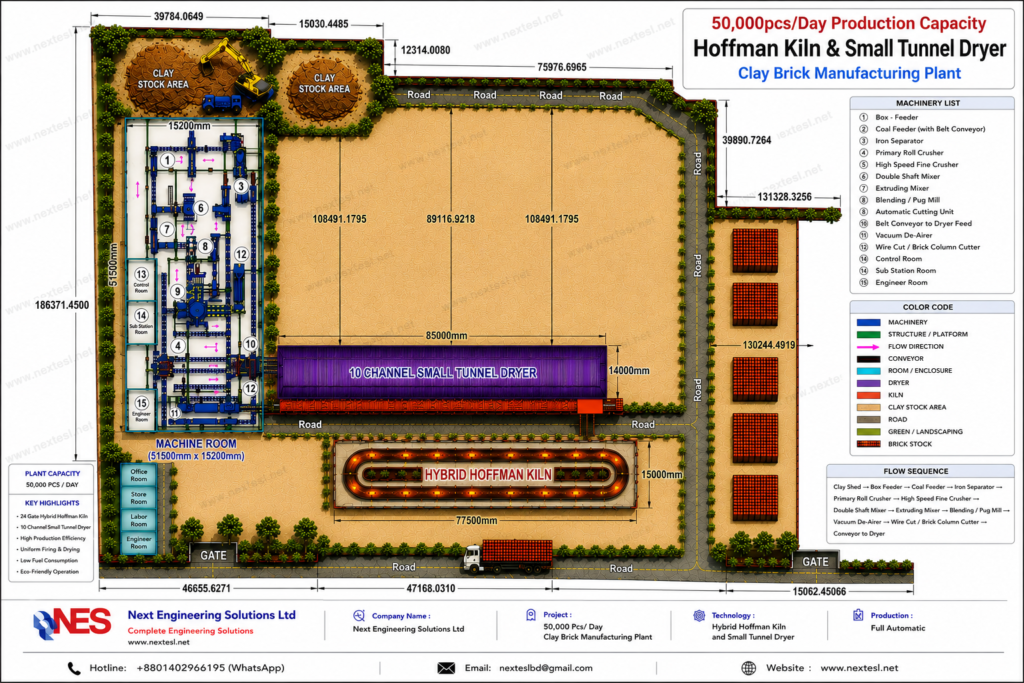
This layout is designed with a 24-door Hybrid Hoffman Kiln and a 10-channel small tunnel dryer. The plant includes clay stock area, machine room, dryer, kiln, finished brick stock yard, internal road, gate, office, substation, and service facilities. The main objective of this layout is to create a smooth production flow from raw clay preparation to finished brick delivery.
Although the designed capacity is 50,000 pcs/day, real production should be calculated more practically. In daily factory operation, production may be affected by clay moisture, machine maintenance, dryer performance, kiln operation, power interruption, labor efficiency, handling loss, drying cracks, and firing rejection. For this reason, a practical assumption of 80% production efficiency is more realistic.
Designed capacity: 50,000 pcs/day
Practical efficiency: 80%
Practical output: 40,000 pcs/day
Brick size: 240 × 115 × 70 mm
Project Overview
This plant is suitable for investors who want an industrial clay brick production line but do not want to start with a very large tunnel kiln project. It offers a good balance between investment, production capacity, operation control, and product quality.
| Item | Specification |
|---|---|
| Designed production capacity | 50,000 pcs/day |
| Practical production assumption | 80% |
| Practical daily output | 40,000 pcs/day |
| Brick size | 240 × 115 × 70 mm |
| Kiln type | 24-door Hybrid Hoffman Kiln |
| Dryer type | 10-channel small tunnel dryer |
| Production type | Automatic / semi-automatic |
| Main technology | Internal fuel mixing, waste heat drying, controlled firing |
The 24-door Hybrid Hoffman Kiln allows continuous loading, firing, cooling, and unloading. The 10-channel dryer supports stable drying before the bricks enter the kiln. Together, the system improves production balance and reduces weather dependency.
Practical Production Calculation
A 50,000 pcs/day design capacity means the plant is engineered to reach this output under ideal operating conditions. However, actual production is usually lower during normal commercial operation.
50,000 × 80% = 40,000 pcs/day
This 40,000 pcs/day practical output is better for calculating daily sales, monthly production, fuel demand, raw material requirement, labor planning, dryer loading, kiln scheduling, and truck delivery.
The selected brick size is 240 mm × 115 mm × 70 mm.
Single brick volume: 0.24 × 0.115 × 0.07 = 0.001932 m³
| Production Basis | Calculation | Brick Volume |
|---|---|---|
| Designed capacity | 50,000 × 0.001932 | 96.60 m³/day |
| Practical output | 40,000 × 0.001932 | 77.28 m³/day |
So, at 80% practical efficiency, the plant produces about 40,000 bricks/day, equal to approximately 77.28 m³/day of fired brick volume.
Technical note: If 240 × 115 × 70 mm is the final fired brick size, the green brick mould size should normally be slightly larger because clay bricks shrink during drying and firing. The exact mould size should be finalized after clay testing.
Hybrid Hoffman Kiln Technology
The Hybrid Hoffman Kiln, also known as HHK, is a continuous moving-fire kiln. In this system, the bricks remain stacked inside the kiln chambers while the firing zone moves gradually through the kiln. This creates three main zones: preheating, firing, and cooling.
In the preheating zone, dried bricks receive heat from hot gas before reaching the firing area. In the firing zone, bricks are burned at high temperature, usually around 950°C to 1050°C, depending on clay quality and product requirement. In the cooling zone, fired bricks gradually release heat before unloading.
A major advantage of HHK technology is the use of internal fuel. Pulverized coal or suitable fuel is mixed with clay during preparation. This allows the brick body to burn more uniformly from inside. Additional fuel may also be added during firing through the kiln roof or feeding points.
The hot flue gas from the kiln can be reused in the dryer. This waste heat recovery reduces fuel loss and improves overall energy efficiency. That is why HHK technology is considered more efficient and cleaner than many traditional brick kiln systems.
Why 24 Doors Are Used
In this layout, the kiln is a 24-door Hybrid Hoffman Kiln. The doors are used for loading, unloading, chamber access, inspection, and operation control. A 24-door arrangement is practical for a 50,000 pcs/day class plant because it supports regular loading and unloading cycles.
However, technically, 24 doors do not always mean 24 equal firing chambers. The actual chamber design depends on kiln length, width, airflow system, stacking pattern, flue gas movement, and firing schedule. The doors simply provide operational access and flexibility.
For proper performance, kiln door sealing, insulation, airflow control, and brick stacking must be maintained carefully. Poor sealing or wrong stacking can cause heat loss, uneven firing, over-burnt bricks, under-burnt bricks, and higher fuel consumption.
10 Channel Small Tunnel Dryer
Drying is one of the most important stages in clay brick production. If green bricks enter the kiln with too much moisture, they may crack, bend, deform, or burst during firing. Natural drying depends heavily on weather and can become slow during rainy or humid seasons.
The 10-channel small tunnel dryer solves this problem by drying green bricks in a controlled environment. Green bricks are placed on dryer cars or trolleys and moved through dryer channels. Hot air flows through the dryer and removes moisture gradually.
A 10-channel dryer is suitable for this plant because it can handle medium-capacity production while keeping the layout compact. It also balances the output of the machine room with the kiln firing requirement.
| Benefit | Practical Value |
|---|---|
| Controlled drying | Reduces cracks and deformation |
| Weather independence | Supports production in rainy season |
| Waste heat use | Reduces drying fuel cost |
| Continuous flow | Keeps kiln supplied with dried bricks |
| Better quality | Improves shape, strength, and color consistency |
The dryer must be properly matched with the kiln. If dryer capacity is too low, the kiln will wait for dried bricks. If the dryer is too large but kiln capacity is limited, dried bricks will accumulate unnecessarily.
Complete Production Process Flow
The production process starts from clay handling and ends with finished brick delivery.
First, clay is collected and stored in the clay stock area. Good clay stock management helps improve plasticity, moisture balance, and material uniformity. Before production, clay should be checked for stones, organic matter, moisture, and shrinkage behavior.
The clay is then fed into the production line by a box feeder. The box feeder controls the material flow and keeps the machinery running smoothly. If the feeding is uneven, the crusher, mixer, extruder, and cutter may face unstable load.
Next, internal fuel such as pulverized coal is added in controlled quantity. This quantity must be decided based on clay test, fuel calorific value, moisture content, firing temperature, and brick type. Too much internal fuel can create black core or over-burning. Too little fuel can increase external fuel consumption.
After feeding, the clay passes through iron separation, crushing, and mixing. Roll crushers and fine crushers reduce clay lumps and improve particle size. The double shaft mixer mixes clay, water, and internal fuel. Proper mixing is essential for uniform drying and firing.
The clay then moves through pug mill and vacuum extrusion. Vacuum de-airing removes trapped air from the clay body and improves density, strength, surface finish, and shape stability. After extrusion, the clay column is cut into green bricks by automatic cutting machines.
Fresh green bricks are transferred to the 10-channel small tunnel dryer. Inside the dryer, moisture is removed gradually using controlled hot air. After drying, bricks are loaded into the Hybrid Hoffman Kiln through the kiln doors.
Inside the kiln, bricks pass through preheating, firing, and cooling. After firing and cooling, the finished bricks are unloaded, sorted, stacked in the finished brick yard, and delivered by truck.
Machinery and Plant Sections
A typical machinery and section list for this plant includes box feeder, coal feeder, belt conveyor, iron separator, roll crusher, fine crusher, double shaft mixer, extruding mixer, pug mill, vacuum extruder, automatic cutter, dryer cars, 10-channel dryer, kiln system, fans, ducting, control room, substation, office, and finished brick stock yard.
The machine room should be directly connected with the dryer so that green bricks can move smoothly from cutting to drying. Unnecessary handling should be avoided because fresh green bricks are soft and can easily deform or break.
Budget and Investment Logic
The budget of a 50,000 pcs/day Hybrid Hoffman Kiln and 10-channel dryer plant depends on many factors. Investors should not calculate only the machinery cost. A complete project includes land development, civil construction, machinery, dryer, kiln, electrical system, installation, working capital, and operational setup.
| Budget Head | Description |
|---|---|
| Land development | Filling, leveling, drainage, boundary, road |
| Civil work | Machine room, dryer, kiln, office, shed |
| Machinery | Feeder, crusher, mixer, extruder, cutter |
| Dryer system | Dryer channels, fans, ducts, trolleys |
| Kiln system | HHK structure, refractory, insulation, doors |
| Electrical system | Motors, cables, panels, substation |
| Installation | Erection, testing, commissioning |
| Working capital | Clay, fuel, labor, spare parts, marketing |
The final cost depends on automation level, machinery origin, steel price, refractory quality, local construction cost, import duty, freight, and power connection. A proper feasibility study should be done before investment.
Advantages of This Layout
This layout offers several practical advantages. The production flow is logical, from clay stock to machine room, dryer, kiln, finished brick yard, and delivery road. This reduces unnecessary movement and improves efficiency.
The 10-channel dryer improves drying quality and reduces dependence on sunlight. The Hybrid Hoffman Kiln reuses waste heat and supports more controlled firing. Internal fuel mixing improves heat distribution inside the brick body and can reduce fuel waste.
The plant is also suitable for medium-scale investment. It provides better production control than traditional manual systems but requires less investment than a large tunnel kiln plant. With proper operation, the plant can produce strong, uniform, and marketable bricks.
Limitations and Challenges
The main limitation is higher initial investment compared with traditional kilns. Skilled operators are also required for dryer control, kiln firing, internal fuel mixing, stacking pattern, and maintenance.
Clay testing is essential before finalizing the project. Without proper clay testing, the plant may face cracking, high shrinkage, black core, weak bricks, poor color, and high rejection.
Regular maintenance is also necessary. Crushers, mixers, extruders, cutters, conveyors, fans, dryer cars, kiln doors, motors, and control panels must be checked properly. Worker safety must also be managed because dust, heat, and handling risks still exist.
Conclusion
The 50,000 pcs/day Hybrid Hoffman Kiln and 10 Channel Small Tunnel Dryer clay brick manufacturing plant is a practical and modern solution for medium-scale brick production.
Although the designed capacity is 50,000 pcs/day, a practical planning output of 40,000 pcs/day at 80% efficiency is more realistic for business calculation. Based on the brick size 240 × 115 × 70 mm, this equals approximately 77.28 m³/day of fired brick volume.
The 24-door Hybrid Hoffman Kiln supports continuous firing, while the 10-channel small tunnel dryer ensures controlled drying and stable kiln feeding. With proper clay testing, machinery selection, dryer-kiln balance, civil design, installation, and operator training, this plant can provide better fuel efficiency, improved brick quality, lower rejection, and stronger business performance.
Why Choose Next Engineering Solutions Ltd.
Next Engineering Solutions Ltd. provides practical engineering support for complete clay brick manufacturing projects, from initial layout planning to machinery selection, kiln and dryer design, installation guidance, and production consultation.
NES focuses on realistic project planning, proper technology selection, and investor-friendly solutions. Instead of only supplying machinery, NES helps clients understand production capacity, practical output, budget logic, process flow, and long-term operational requirements. This makes the project more reliable, technically balanced, and suitable for real factory operation.