Learn how to set up an automatic brick manufacturing plant step by step. Includes feasibility study, machinery selection, cost analysis, installation process, and expert guidance from Next Engineering Solutions Ltd.
🧱 Introduction
The construction industry in Bangladesh and across developing markets is rapidly evolving. Traditional manual brick kilns are being replaced by modern automatic brick manufacturing plants that offer higher efficiency, better quality, and environmental compliance.
Investing in an automated brick production system is not just a business decision—it is a long-term industrial strategy. With increasing demand for housing, infrastructure, and commercial development, the brick manufacturing sector remains one of the most profitable industrial investments.
However, setting up such a plant requires careful planning, technical knowledge, and proper execution. This comprehensive guide explains every step of establishing an automatic brick manufacturing plant, from feasibility study to full production.
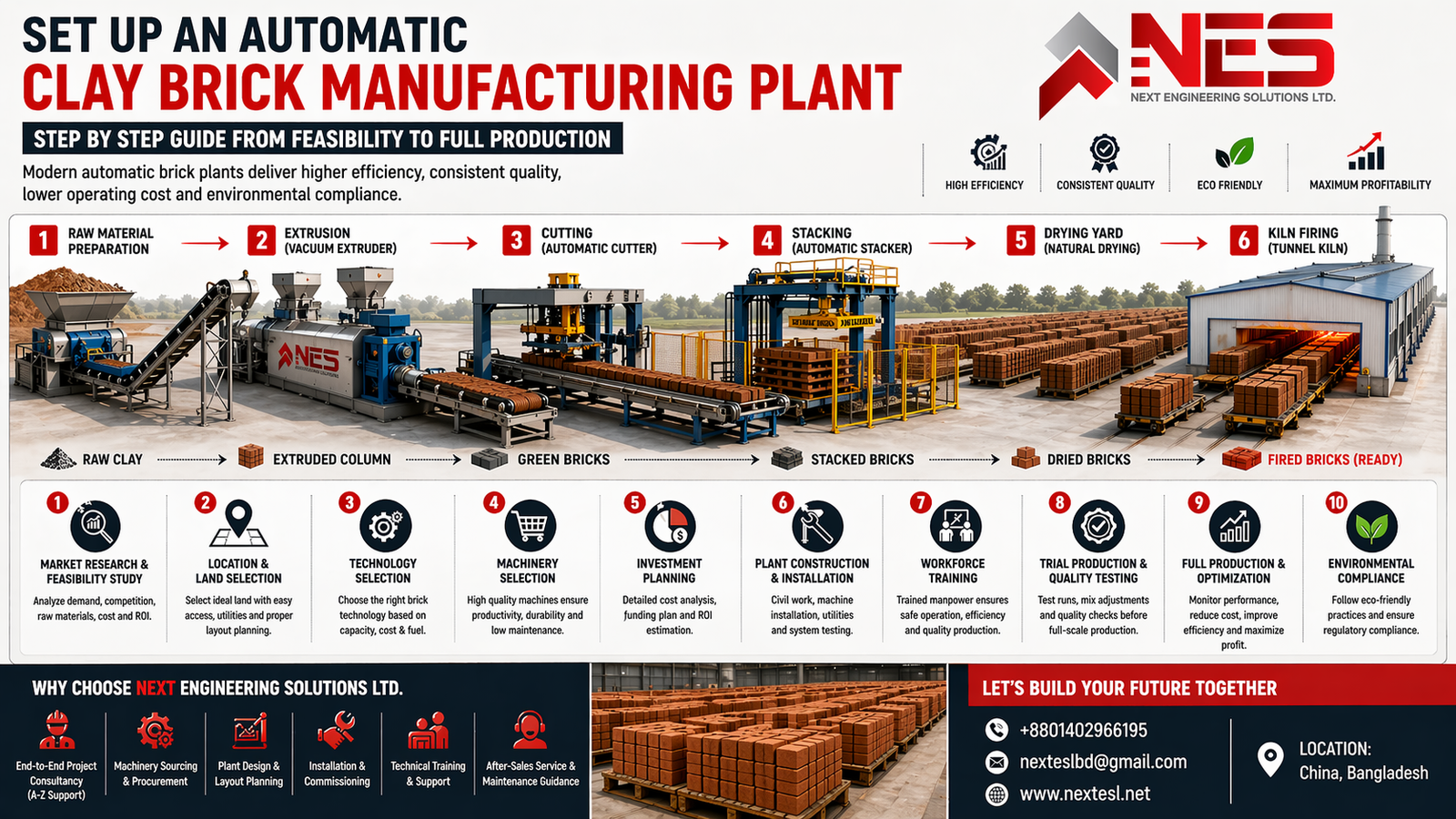
🔍 Step 1: Market Research and Feasibility Study
Before investing in any industrial project, market research is essential. A brick manufacturing plant involves significant capital, so understanding demand and competition is critical.
Key factors to analyze:
- Local construction demand (residential, commercial, infrastructure)
- Existing brick suppliers and market price trends
- Seasonal demand fluctuations
- Availability of raw materials like clay, sand, and cement
- Transportation cost and logistics
Why feasibility study matters:
A feasibility study helps determine:
- Whether the project is financially viable
- Expected return on investment (ROI)
- Break-even timeline
- Risk factors and challenges
Without this step, investors may face unexpected losses or operational inefficiencies.
📍 Step 2: Selecting the Right Location and Land
The success of a brick manufacturing plant heavily depends on location selection.
Ideal land requirements:
- Minimum 2 to 10 acres (depending on plant capacity)
- Easy access to highways and transport routes
- Availability of electricity, water, and gas supply
- Distance from residential and environmentally sensitive areas
- Flat terrain for construction and machinery setup
Layout planning includes:
- Raw material storage zone
- Production line area
- Drying yard (if applicable)
- Kiln or curing zone
- Administrative office
- Maintenance workshop
A well-planned layout ensures smooth workflow and reduces production delays.
⚙️ Step 3: Choosing the Right Technology
Modern brick manufacturing plants use advanced automation systems that significantly improve efficiency.
Main technology options:
1. Automatic Clay Brick Plant
- Uses clay as raw material
- Includes Tunnel Kiln or Hoffman Kiln systems
- High production capacity
- Suitable for large-scale industrial production
2. Concrete Block Manufacturing Plant
- Uses cement, sand, and aggregates
- Uses QT series block machines
- Fully or semi-automatic systems available
- Flexible product output (solid blocks, hollow blocks, pavers)
Comparison factors:
- Production capacity
- Fuel consumption
- Initial investment cost
- Maintenance requirements
- Environmental impact
Choosing the right technology depends on market demand and budget capacity.
🏗️ Step 4: Machinery Selection and Procurement
Machinery is the backbone of any brick manufacturing plant. Selecting high-quality equipment ensures long-term productivity and reduced maintenance costs.
Core machinery includes:
- Raw material crusher and feeder system
- Automatic batching and mixing plant
- Conveyor belt systems
- Brick/block molding machines
- Hydraulic press systems
- Drying and curing systems
- Kiln system (Tunnel or Hoffman)
- Automation and control panels
Important considerations:
- Machine durability and build quality
- Automation level
- Spare parts availability
- Technical support and training
- Energy efficiency
Investing in low-quality machinery may reduce upfront cost but increases long-term operational expenses.
💰 Step 5: Investment Planning and Cost Breakdown
Understanding the cost structure is essential for financial planning.
Major cost components:
- Land acquisition and development
- Machinery procurement and installation
- Civil construction work
- Electrical and gas connection setup
- Labor and workforce hiring
- Operational and maintenance cost
- Raw material stock management
Investment range:
The total investment varies based on:
- Plant capacity (small, medium, large scale)
- Technology type
- Level of automation
ROI expectation:
A well-managed plant can recover investment within 2–5 years depending on market conditions.
🏗️ Step 6: Plant Construction and Installation
Once planning and procurement are complete, the physical setup begins.
Key stages:
- Civil foundation construction
- Machine installation and alignment
- Electrical wiring and automation setup
- Pipeline and utility connection
- System integration testing
Important note:
Professional engineering supervision is essential during installation to ensure:
- Proper alignment of machines
- Safety compliance
- Efficient production flow
Mistakes during installation can lead to long-term operational inefficiencies.
👷 Step 7: Workforce Recruitment and Training
A fully automated plant still requires skilled manpower for operation and maintenance.
Required workforce:
- Machine operators
- Electrical engineers
- Mechanical technicians
- Quality control staff
- Production supervisors
- Administrative personnel
Training importance:
Proper training ensures:
- Smooth machine operation
- Reduced downtime
- Higher production efficiency
- Better product quality
A trained workforce directly impacts profitability.
🔄 Step 8: Trial Production and Quality Testing
Before launching full-scale production, trial runs are essential.
Trial process includes:
- Testing raw material mix ratios
- Adjusting machine settings
- Checking molding accuracy
- Evaluating drying and curing process
- Testing final brick strength
Quality parameters:
- Compressive strength
- Shape and dimension accuracy
- Moisture resistance
- Durability under load
Only after successful testing should full production begin.
📈 Step 9: Full Production and Optimization
Once the plant is operational, focus shifts to optimization.
Key operational practices:
- Continuous production monitoring
- Regular machine maintenance
- Raw material quality control
- Energy consumption optimization
- Waste reduction strategies
Performance improvement:
- Automate reporting systems
- Use sensors for monitoring
- Implement predictive maintenance
Efficient operations lead to higher profit margins.
🌱 Step 10: Environmental Compliance and Sustainability
Modern brick plants must comply with environmental regulations.
Eco-friendly practices:
- Reduced carbon emissions
- Efficient fuel usage
- Dust and waste control systems
- Recycled material usage where possible
Why it matters:
- Government compliance
- Better brand reputation
- Long-term sustainability
- Easier project approvals
Eco-friendly production is becoming a global requirement.
🚀 Why Choose Next Engineering Solutions Ltd
Setting up an automatic brick manufacturing plant requires technical expertise, industry experience, and reliable execution. This is where Next Engineering Solutions Ltd plays a crucial role.
Our services include:
- Complete project consultancy (A–Z support)
- Machinery sourcing and procurement
- Plant design and layout planning
- Installation and commissioning
- Technical training and support
- After-sales service and maintenance guidance
Our advantage:
- Industry experience in industrial automation
- Expertise in brick and block manufacturing systems
- End-to-end project execution capability
- Strong technical support network
We don’t just supply machinery—we build complete industrial solutions.
📊 Conclusion
Setting up an automatic brick manufacturing plant is a highly profitable industrial opportunity when executed with proper planning and technical guidance. From feasibility study to full production, every step plays a crucial role in ensuring success.
With increasing demand for modern construction materials and stricter environmental regulations, automated brick production is the future of the industry.
By partnering with experienced engineering consultants like Next Engineering Solutions Ltd, investors can reduce risks, optimize investment, and achieve long-term industrial success.
About this NES engineering article
Published by: Next Engineering Solutions Ltd — Engineering Content Team.
Technical review lead: Oashim Khan, Chief Engineer. Relevant NES specialists contribute to plant design, machinery, kiln, dryer and project-execution topics.
Meet the contributors and read the NES technical review policy.