Which Clay Brick Manufacturing Plant Is Best for Your Investment?
By Next Engineering Solutions Ltd
The global clay brick manufacturing industry is rapidly evolving toward energy-efficient, automated, and environmentally sustainable technologies. In developing countries such as Bangladesh, India, Nepal, and several African markets, investors are increasingly shifting from traditional kilns to advanced automatic brick manufacturing plants.
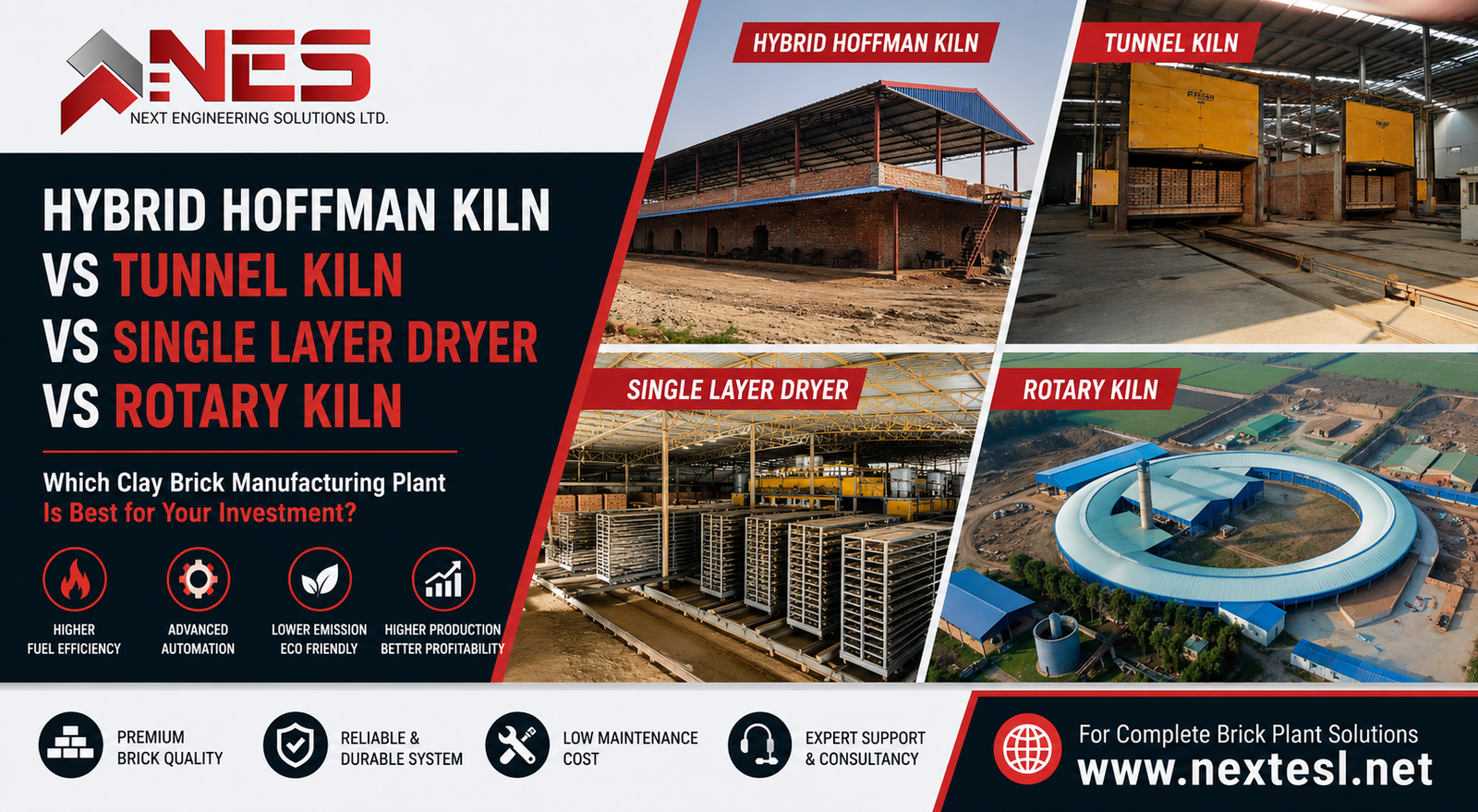
Today, the most widely discussed technologies are:
- Hybrid Hoffman Kiln (HHK)
- Tunnel Kiln
- Single Layer Dryer System
- Rotary Kiln Brick Plant
Each system has its own advantages, limitations, investment structure, automation level, and production capability. Choosing the right plant is one of the most important decisions for any brick manufacturer because the kiln technology directly affects:
- Production cost
- Fuel consumption
- Brick quality
- Labor requirement
- Environmental compliance
- Maintenance expense
- Return on investment (ROI)
- Long-term business sustainability
This detailed technical article by Next Engineering Solutions Ltd explains the differences between these technologies and helps investors determine which plant best suits their business goals.
Understanding Modern Brick Manufacturing Technologies
1. Hybrid Hoffman Kiln (HHK)
Hybrid Hoffman Kiln is an improved version of the traditional Hoffman kiln technology originally developed in Germany and later modernized for higher thermal efficiency and lower emissions.
In HHK systems:
- Bricks remain stationary inside chambers
- The firing zone moves from chamber to chamber
- Waste heat is recovered and reused
- Pulverized coal can be mixed inside green bricks
- Insulated chambers reduce heat loss significantly
According to industrial studies, HHK technology improves energy efficiency through internal fuel combustion and optimized heat circulation systems.
Main Advantages of HHK
- Lower investment compared to tunnel kiln
- Good fuel efficiency
- Better brick quality than traditional kilns
- Year-round production capability
- Reduced smoke emission
- Suitable for medium-scale investors
Limitations
- Requires more labor than tunnel kiln
- Lower automation level
- Chamber management requires skilled operators
- Production scalability is limited compared to tunnel systems
Recommended Production Capacity
50,000 – 150,000 bricks per day
Best Suitable For
- Medium investors
- Upgrading from Fixed Chimney Kiln (FCK)
- Markets requiring standard clay bricks
- Investors seeking moderate automation with lower capital investment
2. Tunnel Kiln Technology
Tunnel Kiln is considered one of the most advanced continuous firing systems used in modern clay brick industries worldwide.
In a tunnel kiln:
- The firing zone remains fixed
- Brick cars move continuously through preheating, firing, and cooling zones
- Temperature is digitally controlled
- Automation systems operate continuously
- Waste heat recovery maximizes thermal efficiency
Industrial research explains that tunnel kilns provide continuous operation with highly automated material handling systems.
Advantages of Tunnel Kiln
1. Fully Automatic Production
Tunnel kilns support:
- Robotic setting systems
- Automatic loading/unloading
- PLC temperature control
- Conveyor automation
- Smart monitoring systems
2. Excellent Brick Quality
Tunnel kilns produce:
- Uniform color
- Higher compressive strength
- Lower breakage ratio
- Better dimensional accuracy
- Premium facing bricks
3. Large-Scale Production
Tunnel kilns are ideal for:
- Industrial-scale manufacturing
- Export-oriented production
- Large construction markets
4. Better Environmental Performance
Tunnel kilns offer:
- Controlled combustion
- Reduced smoke emission
- Better fuel utilization
- Lower environmental impact
Limitations of Tunnel Kiln
- Very high initial investment
- Complex civil construction
- Requires advanced engineering
- Longer installation period
- Higher maintenance cost for sophisticated systems
Recommended Production Capacity
100,000 – 400,000+ bricks per day
Best Suitable For
- Large industrial investors
- Premium brick manufacturers
- Fully automatic plants
- Export-quality brick production
3. Single Layer Dryer System
Single Layer Dryer is not a firing kiln itself. It is a modern drying technology integrated before the firing process.
Traditional drying methods often cause:
- Brick cracking
- Uneven moisture distribution
- Shape deformation
- High rejection rates
Single Layer Dryer systems solve these issues using:
- Controlled airflow
- Automated moisture removal
- Uniform heat circulation
- Continuous drying operation
Advantages of Single Layer Dryer
1. Reduced Drying Loss
Uniform drying significantly lowers:
- Cracks
- Warping
- Drying damage
2. Faster Production
Continuous drying increases overall plant productivity.
3. Improved Brick Quality
The system improves:
- Shape accuracy
- Surface finishing
- Structural consistency
4. Better Energy Utilization
Waste heat from kiln systems can be reused for drying.
Best Suitable With
- Tunnel Kiln
- Hybrid Hoffman Kiln
- Rotary Kiln Systems
Recommended For
- Premium brick manufacturing
- Hollow block production
- High-capacity automatic plants
- Humid and rainy climate regions
4. Rotary Kiln Brick Manufacturing Plant
Rotary Kiln technology is becoming increasingly popular in modern automatic brick manufacturing plants because of its advanced heat distribution and continuous production capability.
Unlike traditional straight tunnel firing systems:
- Rotary movement improves heat distribution
- Thermal stress becomes lower
- Continuous firing efficiency improves
- Maintenance can become easier
Modern rotary kiln systems are designed for:
- Large-scale production
- Lower operational losses
- Better automation
- Higher production efficiency
Advantages of Rotary Kiln
1. Superior Heat Distribution
Rotary systems allow:
- Uniform firing temperature
- Better brick consistency
- Lower firing defects
2. High Automation
The system supports:
- Fully automatic operation
- Continuous production
- Smart process control
- Reduced manual intervention
3. Lower Long-Term Maintenance
Compared with some traditional tunnel structures:
- Thermal stress becomes lower
- Structural wear may reduce
- Operation becomes more stable
4. Environmental Benefits
Rotary systems offer:
- Better fuel combustion
- Reduced heat loss
- Lower emission potential
Limitations of Rotary Kiln
- High investment cost
- Requires experienced engineering team
- Advanced refractory management required
- Technology availability depends on supplier capability
Recommended Production Capacity
200,000 – 600,000+ bricks per day
Best Suitable For
- Large automatic plants
- Industrial investors
- Premium clay brick manufacturers
- High-efficiency modern factories
Technical Comparison Table
| Feature | HHK | Tunnel Kiln | Single Layer Dryer | Rotary Kiln |
|---|---|---|---|---|
| Main Function | Firing | Firing | Drying | Firing |
| Automation Level | Medium | Very High | High | Very High |
| Investment Cost | Medium | Very High | Medium | High |
| Fuel Efficiency | High | Very High | Improves efficiency | Very High |
| Labor Requirement | Moderate | Low | Low | Very Low |
| Brick Quality | Good | Excellent | Enhances quality | Excellent |
| Environmental Performance | Good | Excellent | Excellent | Excellent |
| Production Capacity | Medium | Very High | Supports high capacity | Extremely High |
| Maintenance Complexity | Medium | High | Low | Medium |
| Best for Premium Bricks | Moderate | Excellent | Excellent support | Excellent |
| Scalability | Moderate | Excellent | Excellent | Excellent |
Fuel Consumption Comparison
Fuel cost is one of the largest operational expenses in any brick plant.
Research on modern kiln systems shows that waste heat recovery and controlled combustion significantly reduce energy consumption.
Relative Fuel Consumption
| Technology | Fuel Consumption Level |
|---|---|
| Traditional Kiln | Very High |
| HHK | Medium |
| Tunnel Kiln | Low |
| Rotary Kiln | Very Low |
| Single Layer Dryer Integration | Further reduces energy demand |
Studies in Bangladesh also report that HHK and Tunnel Kiln technologies significantly reduce emissions and improve energy efficiency compared to older kiln technologies.
Which Plant Should Investors Choose?
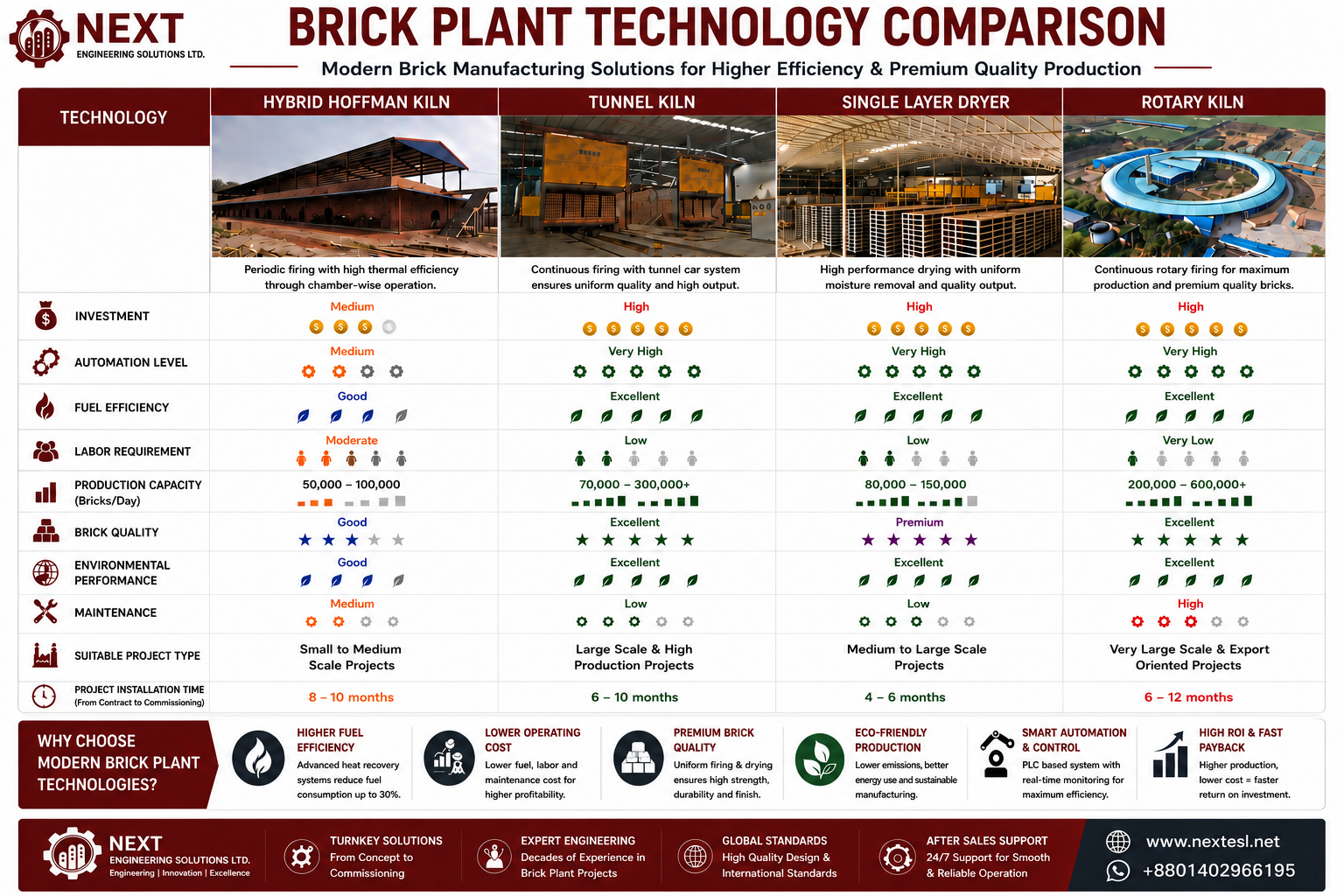
Choose Hybrid Hoffman Kiln (HHK) If:
- Your investment budget is moderate
- You want better efficiency than traditional kilns
- Labor availability is good
- You need medium-scale production
- You want lower investment risk
HHK is currently one of the most practical transition technologies for traditional brick manufacturers.
Choose Tunnel Kiln If:
- You want premium-quality bricks
- You need fully automatic production
- You want long-term industrial scalability
- Environmental compliance is important
- You want lower labor dependency
Tunnel Kiln remains one of the most reliable technologies for large industrial brick projects.
Choose Single Layer Dryer If:
- You want premium-quality drying
- You want lower rejection rates
- You manufacture hollow or facing bricks
- Your region has high humidity or heavy rain
Single Layer Dryer systems are becoming essential for modern automatic brick plants.
Choose Rotary Kiln If:
- You want cutting-edge modern technology
- You plan very large-scale production
- You want maximum automation
- You seek lower long-term operational loss
- You need highly consistent premium brick quality
Rotary Kiln systems are increasingly becoming the future of high-capacity brick manufacturing.
Why Choose Next Engineering Solutions Ltd?
Next Engineering Solutions Ltd provides complete engineering and technical solutions for modern clay brick manufacturing plants, including:
- Tunnel Kiln Projects
- Hybrid Hoffman Kiln Projects
- Rotary Kiln Solutions
- Single Layer Dryer Systems
- Automatic Brick Plant Machinery
- Kiln Design & Engineering
- Plant Layout Design
- Installation & Commissioning
- Technical Consultancy
- Automation Solutions
- Production Optimization
The company focuses on:
- Energy-efficient technologies
- Eco-friendly solutions
- Modern automation
- High-quality brick production
- Long-term industrial sustainability
Final Conclusion
There is no single kiln technology suitable for every investor.
The correct choice depends on:
- Investment capability
- Production target
- Fuel availability
- Land size
- Labor cost
- Environmental regulations
- Desired automation level
- Product quality goals
For Medium Investment:
Hybrid Hoffman Kiln is a practical and efficient solution.
For Large Industrial Projects:
Tunnel Kiln remains the global benchmark for premium automated brick production.
For Advanced Modernization:
Rotary Kiln technology offers excellent potential for future-ready brick manufacturing.
For Better Product Quality:
Single Layer Dryer systems are essential for modern automatic plants.
The future of clay brick manufacturing is moving toward:
- Energy efficiency
- Automation
- Waste heat recovery
- Environmental sustainability
- Precision drying and firing
Investors who choose the right technology today will gain stronger long-term profitability, better market competitiveness, and sustainable industrial growth.
For complete project consultation and modern brick plant solutions, visit:
About this NES engineering article
Published by: Next Engineering Solutions Ltd — Engineering Content Team.
Technical review lead: Oashim Khan, Chief Engineer. Relevant NES specialists contribute to plant design, machinery, kiln, dryer and project-execution topics.
Meet the contributors and read the NES technical review policy.