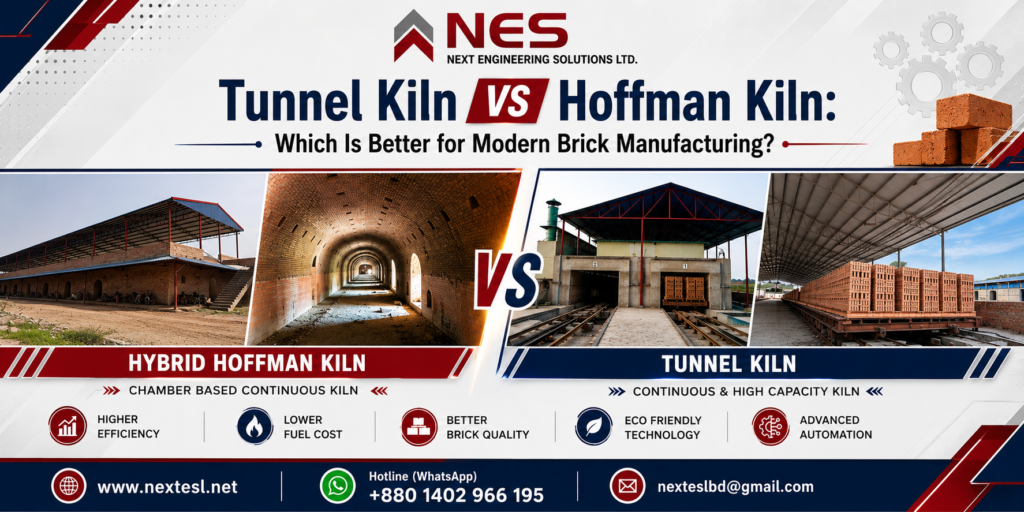
🏭 Tunnel Kiln vs Hybrid Hoffman Kiln: Which Is Better for Modern Brick Manufacturing?
Complete technical comparison for modern clay brick manufacturers by Next Engineering Solutions Ltd.
Modern brick manufacturing is rapidly changing. Rising fuel costs, increasing environmental regulations, labor shortages, and demand for premium-quality bricks are forcing manufacturers to adopt more efficient technologies.
Among the most widely used firing technologies today, Tunnel Kilns and Hoffman Kilns remain two major options. While both systems are designed for continuous brick firing, they differ significantly in automation, production efficiency, operating costs, and long-term profitability.
If you are planning a new brick manufacturing project or upgrading an existing factory, understanding these differences can save significant operating costs and improve product quality.
🔥 What Is a Tunnel Kiln?
A Tunnel Kiln is a continuous firing system where bricks move through a long insulated tunnel using kiln cars while heat remains fixed. Bricks gradually pass through:
✅ Pre-heating Zone
✅ Firing Zone
✅ Cooling Zone
Heat recovered from fired products is reused to preheat incoming bricks, improving fuel efficiency and reducing operating costs. Continuous kilns recycle heat and improve thermal performance. Continuous kiln heat recovery principles are widely documented in kiln engineering references.
Key Features
⚙️ Fully automatic operation
📈 High production capacity
♻️ Waste heat recovery
🎯 Uniform firing quality
👷 Low labor requirement
🧱 What Is a Hoffman Kiln?
The Hoffman Kiln, developed by Friedrich Hoffmann in 1858, consists of multiple chambers arranged in an oval or circular structure. Unlike tunnel kilns, bricks remain stationary while the firing zone gradually moves between chambers. Hoffman kilns use chamber-to-chamber heat transfer and recovery principles.
Key Features
⚙️ Chamber-based system
🏭 Continuous firing operation
💰 Lower initial investment
👷 Medium labor requirement
🔧 Semi-automatic operation
📊 Tunnel Kiln vs Hoffman Kiln: Technical Comparison
| Parameter | Tunnel Kiln | Hoffman Kiln |
|---|---|---|
| Production Capacity | 70,000–300,000+ bricks/day | 50,000–100,000 bricks/day |
| Automation Level | Very High | Medium |
| Labor Requirement | Low | Medium–High |
| Product Quality | Excellent | Good |
| Fuel Consumption | Lower | Moderate |
| Temperature Control | PLC Automatic | Semi-manual |
| Investment | High | Medium |
| Environmental Performance | Better | Moderate |
| Production Stability | Excellent | Moderate |
Modern kiln technologies significantly improve efficiency and lower energy use compared with older brick firing methods.
⚡ Fuel Efficiency & Energy Savings
Fuel cost is one of the largest expenses in brick manufacturing.
Modern Tunnel Kiln systems use:
🔥 Waste Heat Recovery Systems
🌡️ Controlled temperature zones
⚙️ PLC automation systems
Benefits include:
✅ Lower coal or gas consumption
✅ Reduced heat loss
✅ Improved thermal efficiency
✅ Lower production cost
🎯 Brick Quality Comparison
Tunnel Kiln Advantages
✔ Uniform brick color
✔ Better compressive strength
✔ Lower breakage rates
✔ Consistent dimensions
✔ High-quality finished products
Suitable for:
🏗️ Facing bricks
🏗️ Hollow clay blocks
🏗️ Engineering bricks
🏗️ Premium construction materials
Hoffman Kiln Limitations
❌ Temperature variation between chambers
❌ More manual operation
❌ Product consistency may vary
🌱 Environmental Performance
Environmental regulations are becoming increasingly strict worldwide.
Modern Tunnel Kiln technology generally offers:
♻️ Better combustion efficiency
🌍 Lower emissions
💨 Reduced fuel consumption
⚡ Better energy utilization
Research indicates modern kiln technologies improve environmental performance and energy efficiency.
💰 Investment Analysis
Tunnel Kiln
Advantages
✅ Long-term fuel savings
✅ Higher automation
✅ Better product quality
✅ Reduced labor costs
Limitations
❌ Higher initial investment
❌ Requires technical expertise
Hoffman Kiln
Advantages
✅ Lower startup cost
✅ Suitable for medium-scale operations
✅ Easier implementation
Limitations
❌ Higher manpower requirement
❌ Lower automation
🏆 Which Kiln Is Better for Modern Brick Manufacturing?
Choose Tunnel Kiln if:
✔ Production exceeds 100,000 bricks/day
✔ Premium quality is required
✔ Automation matters
✔ Fuel savings are a priority
✔ Long-term profitability is important
Choose Hoffman Kiln if:
✔ Initial budget is limited
✔ Production scale is moderate
✔ Semi-automatic operation is acceptable
For most modern industrial facilities, Tunnel Kiln technology has become the preferred solution because of its efficiency, automation, and product quality advantages.
💡 Final Thoughts
Modern brick manufacturing is no longer only about producing bricks—it is about consistent quality, fuel efficiency, environmental sustainability, automation, and long-term profitability.
While Hoffman Kilns remain a practical solution for medium-scale production facilities, Tunnel Kilns offer the technology required for high-capacity, automated, and future-ready brick manufacturing plants.
For manufacturers looking to improve production efficiency, reduce operational costs, and maintain premium product quality, Tunnel Kiln technology has become one of the strongest long-term investments in the modern brick industry.
Choosing the right kiln system ultimately depends on your production goals, investment capability, and future expansion plans—but for many large-scale projects, Tunnel Kiln systems continue to lead the way in modern clay brick manufacturing.
🚀 Why Choose ?
NES provides complete turnkey solutions for modern clay brick manufacturing plants.
✔ Advanced Tunnel Kiln expertise
✔ High-quality brick machinery supply
✔ Plant design & engineering support
✔ Energy-efficient solutions
✔ Automation & technical consultation
✔ Reliable after-sales service
NES helps clients build smart, efficient, and profitable brick manufacturing plants designed for future growth.
About this NES engineering article
Published by: Next Engineering Solutions Ltd — Engineering Content Team.
Technical review lead: Oashim Khan, Chief Engineer. Relevant NES specialists contribute to plant design, machinery, kiln, dryer and project-execution topics.
Meet the contributors and read the NES technical review policy.