
Technical Guide for Clay Brick Plant Owners & Investors
Green Brick Drying Problems in Tunnel Dryers: Causes and Practical Solutions
Drying is one of the most critical stages in automatic clay brick manufacturing. Proper dryer design, controlled airflow, humidity balance, temperature curve, and correct stacking pattern can reduce cracks, deformation, collapse, wet bricks, fuel loss, and kiln rejection.
Main Problem
Fast or uneven moisture removal creates cracks, bending, collapse, and high rejection.
Main Control Point
Temperature, humidity, airflow, drying time, and stacking pattern must work together.
NES Approach
Design the dryer based on clay property, plant capacity, climate, and kiln heat recovery.
Article Quick Navigation
Why Green Brick Drying Is So Important in Clay Brick Manufacturing
In an automatic clay brick manufacturing plant, drying is not simply the removal of water. It is a controlled engineering process where moisture, heat, airflow, humidity, brick strength, and clay shrinkage must be balanced carefully.
After extrusion and cutting, green bricks still contain moisture and remain sensitive to handling, temperature change, and airflow. Before entering the kiln, the moisture must be removed safely. If the outer surface dries faster than the inner core, internal stress develops inside the brick body. This stress can create surface cracks, corner cracks, warping, collapse, or hidden weakness that later becomes visible inside the kiln.
For this reason, the performance of a tunnel dryer or small tunnel dryer directly affects kiln efficiency, fuel consumption, final brick quality, production stability, and factory profitability.
Tunnel Dryer Process Flow for Green Bricks
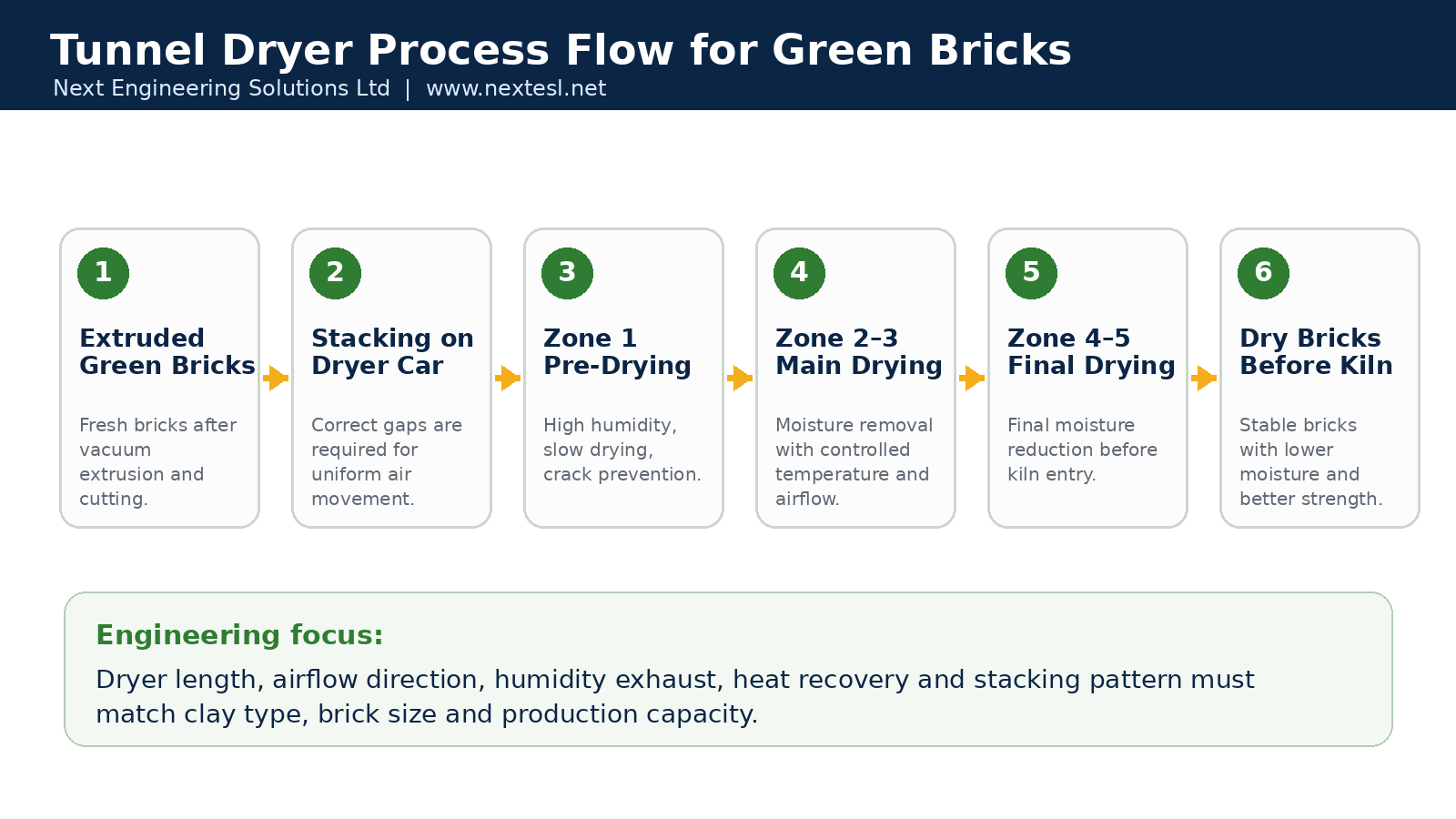
A proper drying process usually starts after vacuum extrusion, cutting, and stacking. The green bricks are loaded onto dryer cars or pallets with correct air gaps. Then they pass through different drying zones where temperature and humidity are controlled step by step.
The early zone should be gentle because the brick body is still wet and weak. The middle zones remove more moisture with controlled airflow. The final zones reduce the remaining moisture before kiln entry. If the drying process is too aggressive in the beginning, cracks and deformation become common.
Common Green Brick Drying Problems and Practical Solutions
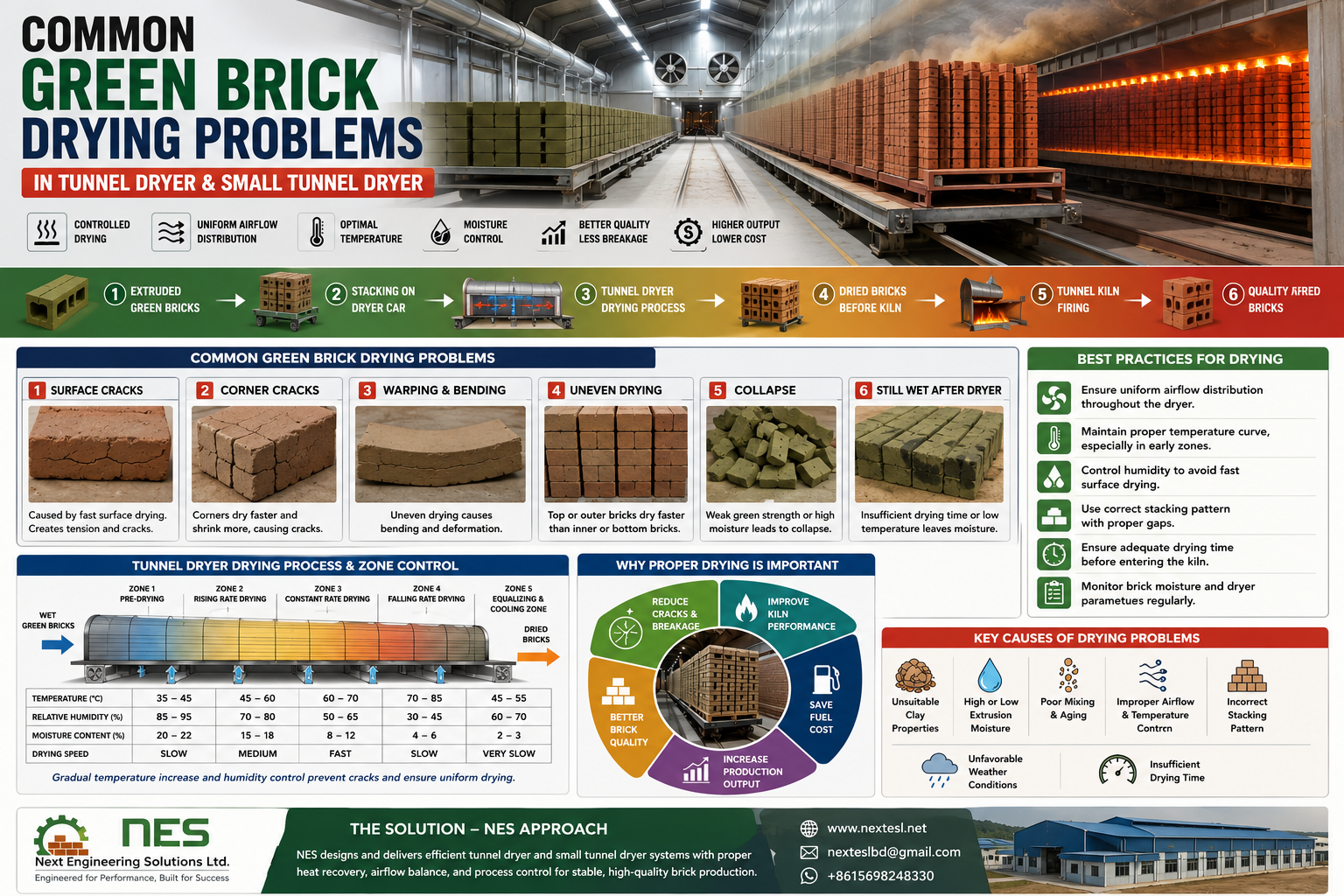
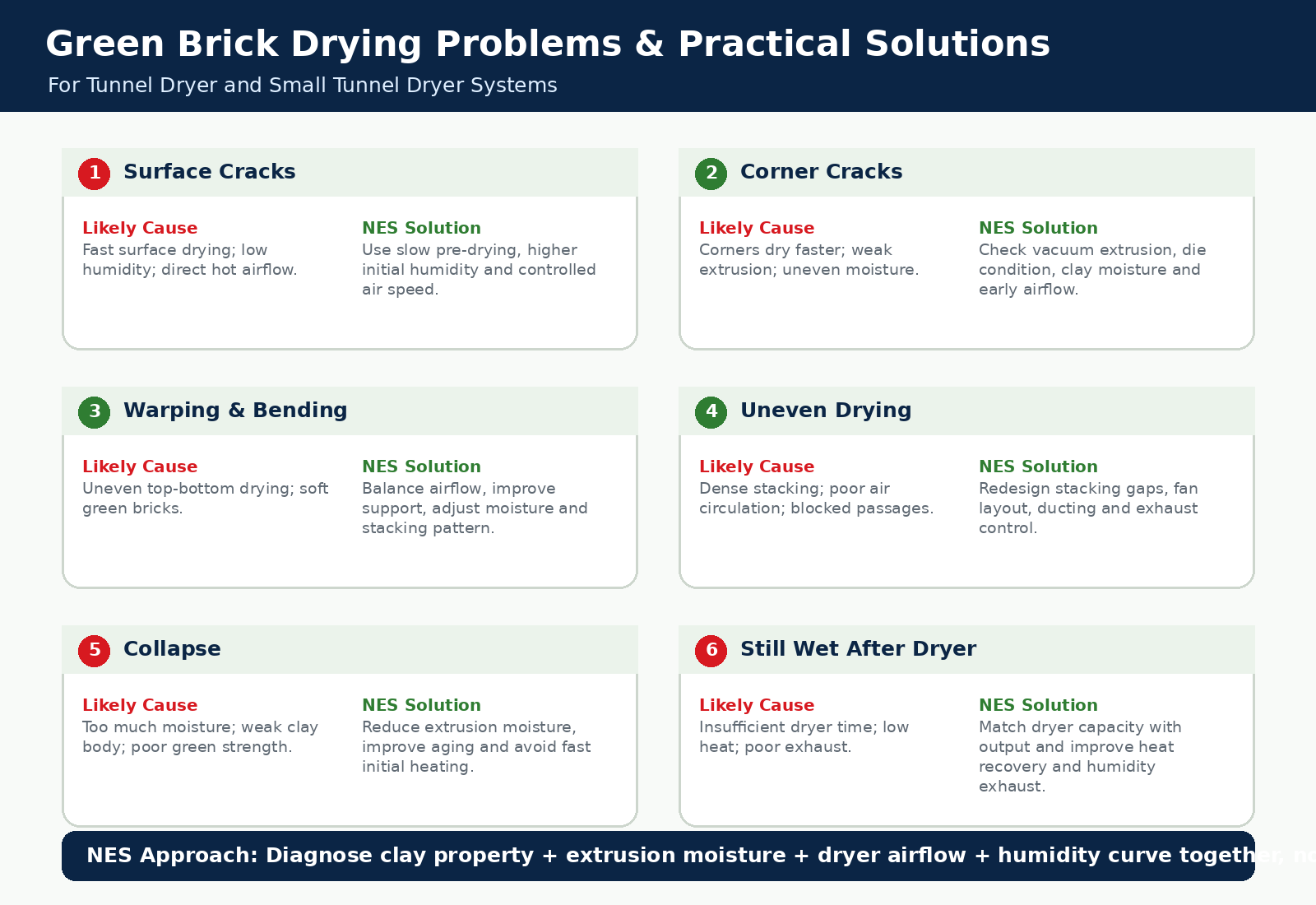
1. Surface Cracks
Surface cracks usually happen when the outside layer dries too quickly while the inner part still contains moisture. This creates tension and visible cracks on the face or side of the brick.
Solution: Use slow pre-drying, controlled humidity, gradual temperature increase, and avoid direct high-speed hot air in the early drying stage.
2. Corner Cracks
Corners are exposed to air from multiple directions, so they dry faster than the center. Corner cracks may also come from weak extrusion, poor vacuum, or uneven clay moisture.
Solution: Check vacuum extrusion, die mouth condition, clay moisture, mixing quality, and control early-zone airflow.
3. Warping and Bending
Warping happens when one side of the brick dries faster than the other. It may also occur when the green brick is too soft or not properly supported during drying.
Solution: Balance airflow, maintain correct stacking gaps, improve green brick strength, and adjust extrusion moisture.
4. Uneven Drying
Top bricks may dry faster than bottom bricks. Outer rows may dry while inner rows remain wet. This problem usually comes from poor airflow circulation or dense stacking.
Solution: Improve fan layout, ducting, exhaust, air passage, dryer car loading height, and robot stacking pattern.
5. Green Brick Collapse
Collapse occurs when green bricks are too wet, too weak, or loaded before gaining enough strength. It can also happen due to poor stacking support or unstable dryer car movement.
Solution: Reduce excessive moisture, improve aging, increase green strength, and avoid fast initial heating.
6. Bricks Still Wet After Dryer
If bricks look dry outside but remain wet inside, they may crack or burst during firing. Wet bricks also increase kiln fuel consumption and reduce production efficiency.
Solution: Match dryer length with production capacity, improve waste heat recovery, control exhaust humidity, and ensure adequate residence time.
Tunnel Dryer Zone Control: Temperature, Humidity and Moisture
A professional tunnel dryer should not operate at one fixed temperature from start to finish. Green bricks need a controlled drying curve. In the early zone, humidity should remain higher and drying speed should be slower. In the middle zone, moisture can be removed more actively. In the final zone, the remaining moisture is reduced before kiln firing.
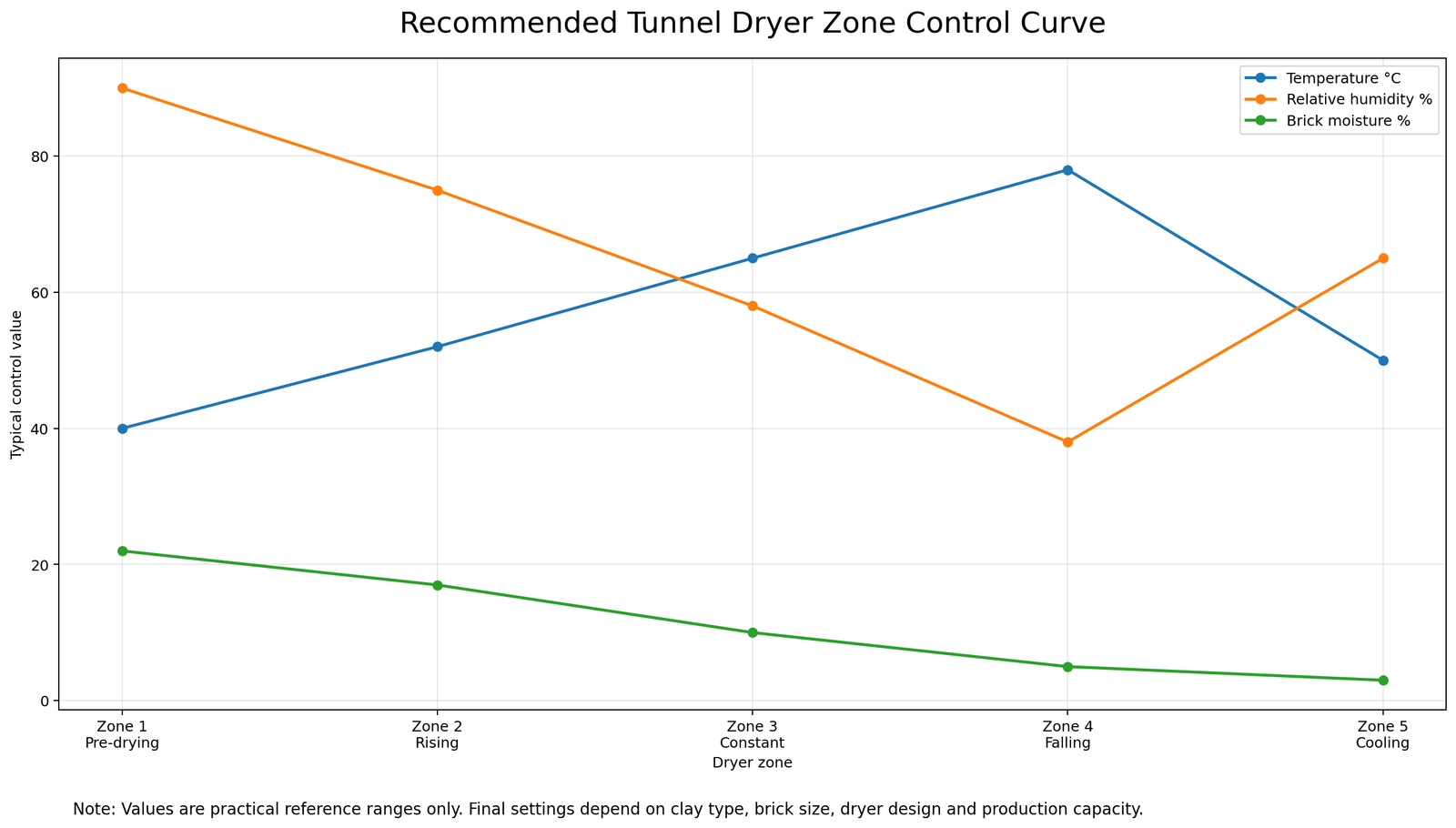
| Dryer Zone | Main Purpose | Control Focus | Risk if Wrong |
|---|---|---|---|
| Zone 1: Pre-Drying | Remove surface moisture slowly | High humidity, low temperature | Surface cracks and corner cracks |
| Zone 2: Rising Rate | Increase drying safely | Balanced heat and airflow | Warping and uneven drying |
| Zone 3: Main Drying | Remove major moisture volume | Stable temperature and circulation | Wet core and high kiln loss |
| Zone 4: Final Drying | Reduce final moisture | Controlled exhaust and heat recovery | Still wet after dryer |
| Zone 5: Equalizing/Cooling | Prepare bricks for kiln entry | Moisture equalization | Firing cracks and kiln instability |
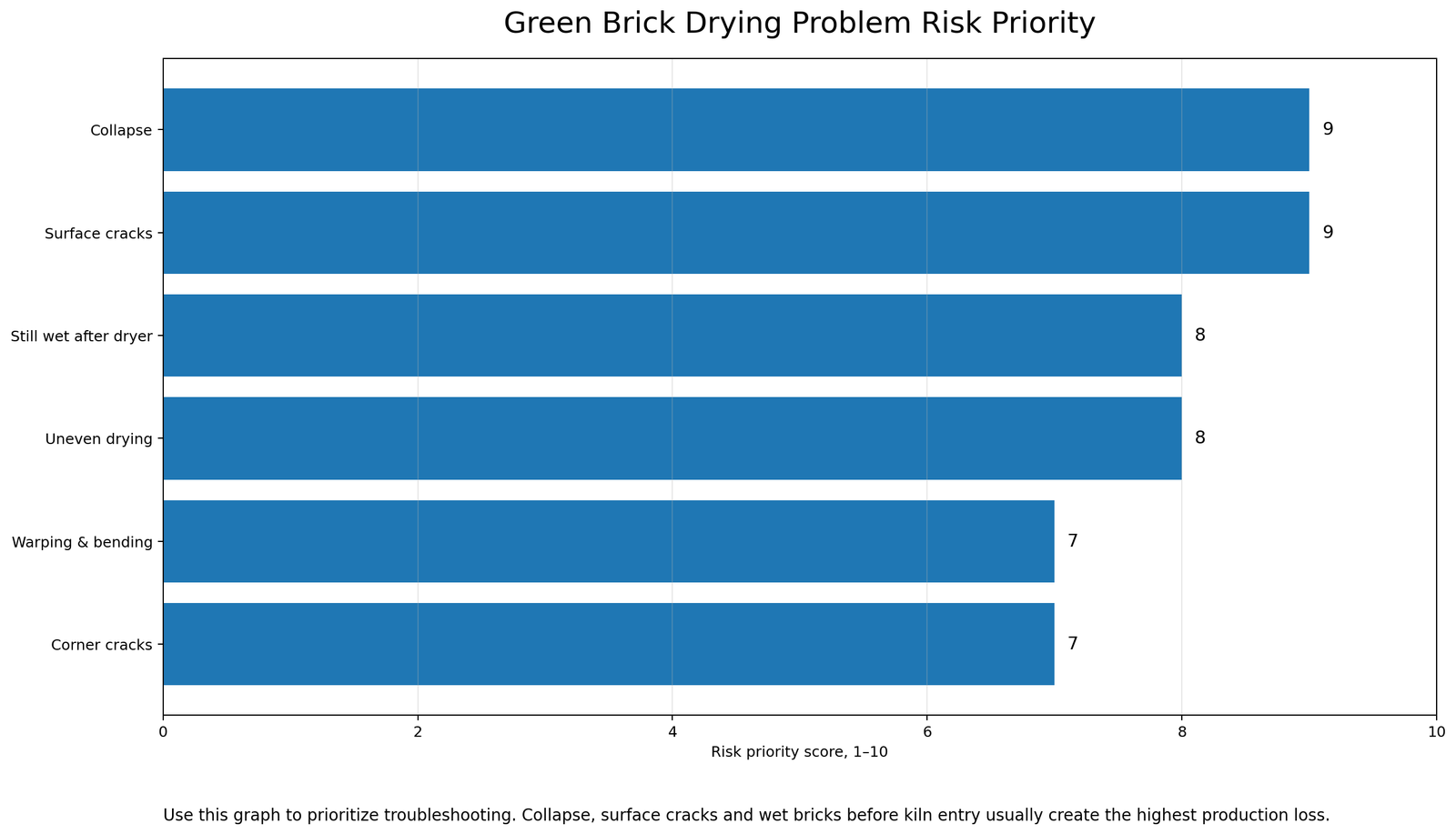
Which Drying Problems Create the Highest Production Risk?
All drying problems are important, but some create greater financial loss than others. Collapse, surface cracks, and wet bricks before kiln entry usually create the highest rejection rate because they directly affect handling, dryer car loading, kiln firing, and final brick strength.
Root Causes of Green Brick Drying Defects
Drying defects are rarely caused by one single reason. A crack may appear inside the dryer, but the real cause may start from clay preparation, moisture control, poor extrusion, weak green strength, wrong stacking pattern, or incorrect airflow design.
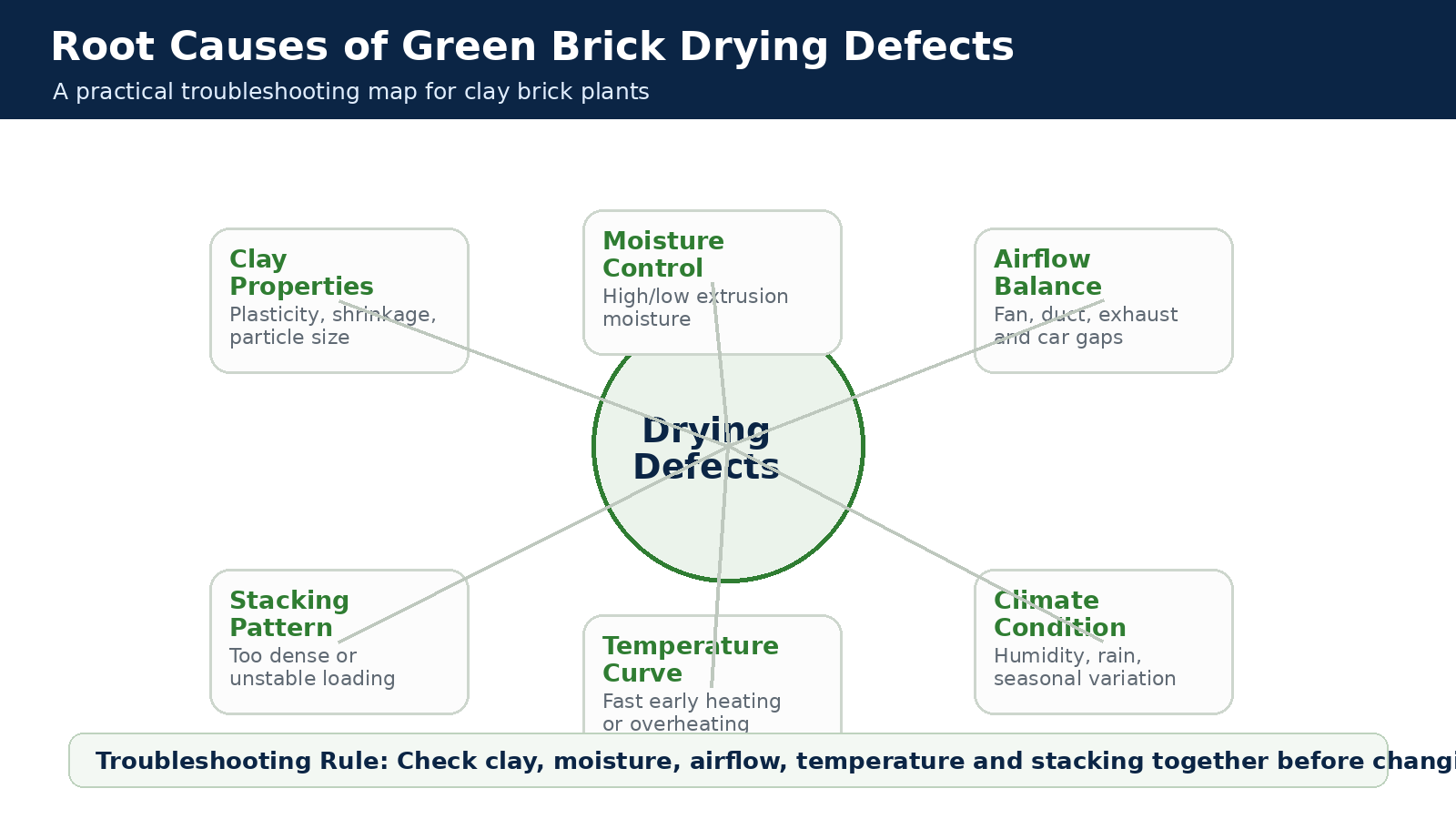
Clay Properties
High plasticity, excessive shrinkage, poor particle balance, and unsuitable clay blending can make bricks sensitive to drying cracks.
Moisture Control
Too much water causes collapse and deformation. Too little water creates poor extrusion and weak bonding.
Airflow Balance
Incorrect fan placement, blocked air passage, or direct hot air impact can create uneven drying and cracking.
Stacking Pattern
Dense or unstable stacking reduces air circulation and increases uneven moisture removal.
Tunnel Dryer vs Small Tunnel Dryer: Which System Is Better?
Both tunnel dryer and small tunnel dryer can work successfully when designed correctly. The selection depends on production capacity, investment level, land size, kiln type, climate, fuel source, automation level, and clay behavior.
| Item | Tunnel Dryer | Small Tunnel Dryer |
|---|---|---|
| Best For | Medium to high-capacity automatic plants | Medium-capacity or investment-controlled projects |
| Heat Source | Usually kiln waste heat recovery | Kiln waste heat or auxiliary heat support |
| Production Stability | High stability with continuous operation | Good stability when capacity is correctly matched |
| Investment Level | Higher | More economical |
| Application | Tunnel kiln plant and fully automatic production line | Hybrid Hoffman kiln, medium automatic line, or upgrading from traditional drying |
Best Practices to Reduce Green Brick Drying Problems
1. Test Clay Before Design
Check plasticity, shrinkage, moisture behavior, and drying sensitivity before finalizing the dryer layout.
2. Control Extrusion Moisture
Uniform moisture improves green brick strength, shape stability, and drying performance.
3. Maintain Proper Air Gaps
Correct stacking pattern allows air to pass through the brick body evenly.
4. Avoid Fast Early Drying
The first dryer zone should protect the brick from rapid surface shrinkage.
5. Use Kiln Waste Heat Properly
Stable heat recovery improves drying efficiency and reduces additional fuel requirement.
6. Monitor Final Moisture
Before kiln entry, bricks should be sufficiently dried to avoid firing cracks and energy loss.
Daily Dryer Operation Checklist
✅ Check clay moisture before extrusion
✅ Check green brick shape after cutting
✅ Inspect cracks before dryer loading
✅ Confirm stacking gap and loading height
✅ Monitor dryer temperature by zone
✅ Monitor humidity and exhaust condition
✅ Check airflow and fan operation
✅ Check final moisture before kiln entry
✅ Record crack pattern and rejection rate
✅ Adjust dryer speed according to real condition
How Next Engineering Solutions Ltd Helps Reduce Drying Problems
Next Engineering Solutions Ltd supports investors and factory owners with practical clay brick plant planning, clay preparation system selection, tunnel dryer design, small tunnel dryer planning, kiln and dryer heat recovery design, layout preparation, installation guidance, commissioning, and production improvement.
For a new project, NES reviews clay condition, production target, brick size, land size, climate, fuel source, and investment level before recommending the most suitable drying system. For existing plants, NES can help analyze drying cracks, uneven drying, poor airflow, low green strength, wet bricks after dryer, and kiln moisture-related defects.
A successful drying system is not only a chamber with hot air. It is a complete engineering system that must be connected with raw material preparation, vacuum extrusion, stacking method, kiln heat recovery, and daily operation control.
Need Technical Support?
Plan Your Clay Brick Dryer, Kiln and Complete Automatic Brick Plant with NES
Next Engineering Solutions Ltd provides turnkey support for tunnel kiln plants, hybrid Hoffman kiln plants, rotary kiln plants, tunnel dryer systems, small tunnel dryer systems, clay brick machinery, installation, commissioning and production improvement.
Frequently Asked Questions
Why do green bricks crack during drying?
Green bricks usually crack when the surface dries faster than the inner core. This creates internal stress. High temperature, low humidity, direct airflow, high clay shrinkage, and poor moisture control can increase cracking.
What is the difference between tunnel dryer and small tunnel dryer?
A tunnel dryer is usually used for larger automatic brick plants and continuous production. A small tunnel dryer is suitable for medium-capacity or investment-controlled projects, especially where weather-controlled drying is needed.
Can kiln waste heat be used for green brick drying?
Yes. Kiln waste heat is commonly used for tunnel dryer and small tunnel dryer systems. Proper heat recovery can improve drying efficiency and reduce additional fuel consumption.
How can NES help with drying problems?
NES can review clay condition, extrusion moisture, stacking pattern, dryer airflow, humidity control, temperature curve, kiln heat recovery, and plant layout to recommend practical engineering solutions.
About this NES engineering article
Published by: Next Engineering Solutions Ltd — Engineering Content Team.
Technical review lead: Oashim Khan, Chief Engineer. Relevant NES specialists contribute to plant design, machinery, kiln, dryer and project-execution topics.
Meet the contributors and read the NES technical review policy.