Carbon Capture and Circular Economy in Clay Brick Plants: A Future-Ready Path to Climate-Positive Brick Manufacturing
A practical engineering guide for modern clay brick manufacturers who want to reduce fuel loss, reuse waste materials, improve kiln efficiency, prepare carbon documentation and move toward future-ready low-carbon brick production.
The global brick manufacturing industry is entering a new stage. Investors, governments, builders and environmental authorities are no longer looking only at production capacity, brick strength and project cost. They are also asking a bigger question: how can a brick plant produce high-quality construction materials while reducing its environmental impact?
For clay brick manufacturers, this is not a small challenge. Fired clay bricks require raw material extraction, clay preparation, drying, firing, cooling, handling and transportation. Among these stages, kiln firing, drying energy, fuel selection, raw material sourcing and plant efficiency play a major role in the total carbon footprint of the final brick.
This is where carbon capture and the circular economy become important. A climate-positive brick plant is not only a plant that reduces emissions. It is a plant that measures its impact, reduces waste, reuses materials, improves energy efficiency and gradually moves toward technologies that can capture, store or offset carbon in a verified way.
What Does Climate-Positive Mean for a Brick Plant?
The term climate-positive means a product, process or project goes beyond reducing emissions and creates a net positive environmental effect. In practical industrial terms, a brick plant can move toward climate-positive manufacturing through three major steps.
First, it must reduce direct emissions from fuel combustion, inefficient firing and poor heat management. Second, it must reduce indirect emissions by optimizing electricity use, raw material transport, waste handling and production losses. Third, it must introduce carbon storage, carbon capture, waste reuse, recycled content or verified environmental offset systems.
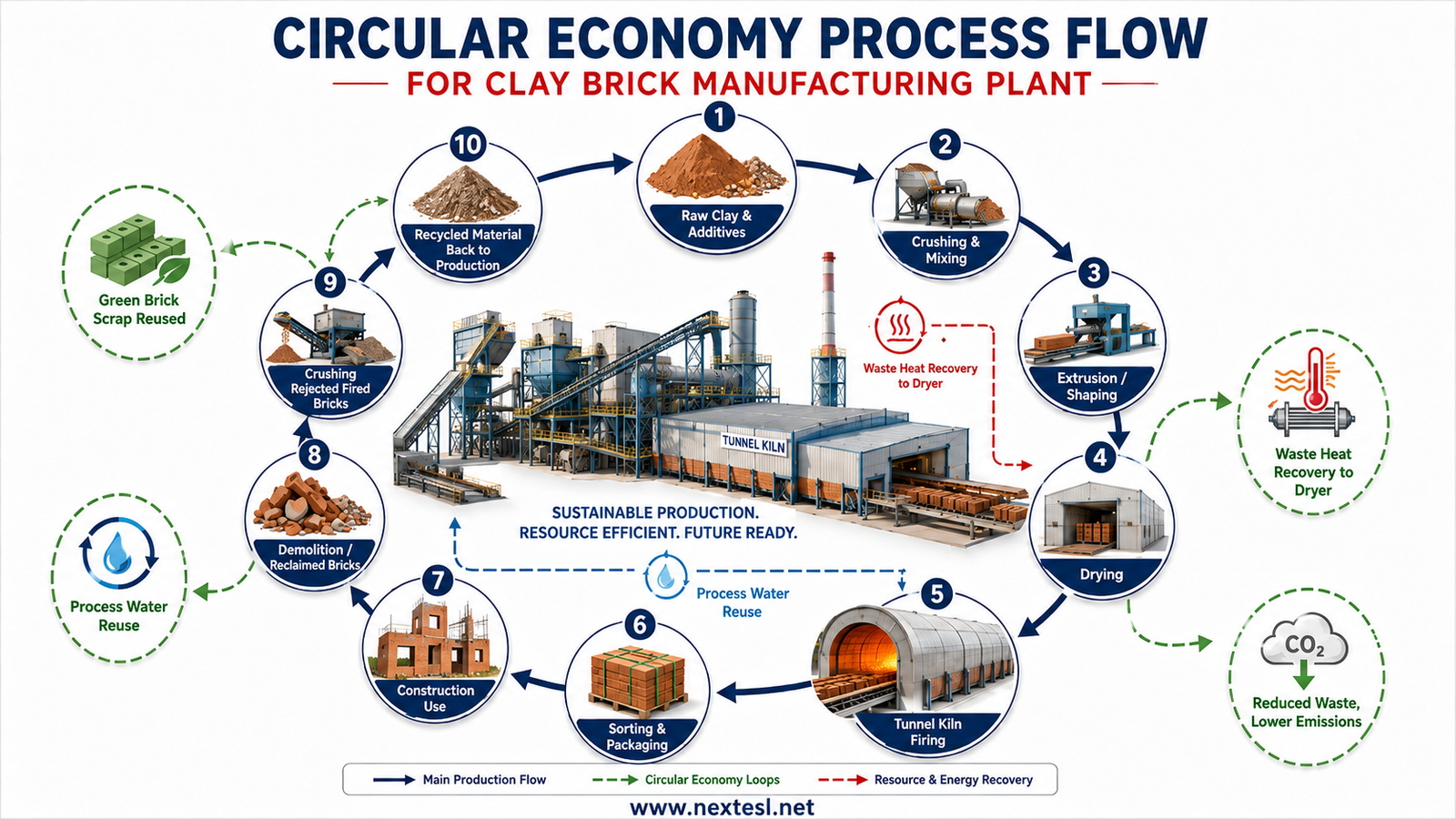
Circular economy process flow for a modern clay brick manufacturing plant, showing raw material preparation, drying, tunnel kiln firing, recycling loops, waste heat recovery and resource reuse.
Why Carbon Footprint Matters in Clay Brick Manufacturing
A brick is a simple product from the outside, but the manufacturing process is complex. Clay must be excavated, crushed, mixed, aged, extruded, cut, dried, fired and cooled. Every stage creates cost and environmental impact.
In traditional plants, a major problem is that energy data is often not measured properly. Fuel consumption, dryer efficiency, kiln firing curves, rejection rates and moisture control are not always recorded in a systematic way. Without measurement, carbon reduction becomes guesswork.
Modern investors should look at carbon footprint from the beginning of project planning. If the plant layout, kiln section, dryer design, air circulation, waste heat ducting and automation system are designed correctly, the plant can reduce fuel consumption and improve brick quality at the same time.
Fuel Efficiency
Better kiln insulation, controlled firing curves and optimized combustion reduce fuel loss.
Dryer Control
Stable airflow, humidity balance and waste heat utilization reduce cracks and drying losses.
Lower Rejection
Proper clay preparation and automation reduce broken, under-burnt and over-burnt bricks.
Carbon Capture in Brick Manufacturing: Current and Future Possibilities
Carbon capture means capturing carbon dioxide before it is released into the atmosphere, or designing materials that absorb and store carbon during or after production. In heavy industries such as cement, steel and ceramics, carbon capture is becoming an important area of research and investment.
For clay brick plants, carbon capture can be divided into four practical areas.
Point-Source Carbon Capture
Capturing CO₂ from kiln exhaust gas before it exits the chimney. More suitable for large-scale future industrial clusters.
Mineral Carbonation
CO₂ reacts with minerals and becomes stable carbonate material, permanently locking carbon into solid form.
Biochar-Based Storage
Biochar and biomass-based materials may support carbon storage if tested properly for clay behavior and final brick quality.
Direct Air Capture Concepts
New-generation materials are being developed to absorb CO₂ directly from air and store it inside the material.
Hybrid Product Lines
Clay-based, earth-based and low-temperature products may become future additions for sustainable building markets.
Carbon Documentation
Verified data, LCA reports and EPD documentation can help plants compete in premium and export markets.
Circular Economy in Clay Brick Manufacturing
The circular economy means designing production so that waste becomes a resource. Instead of extracting raw materials, producing bricks, selling bricks and dumping waste, a circular brick plant tries to keep materials in use for as long as possible.
Green Brick Scrap
Broken green bricks can often be returned to the clay preparation line, reducing raw material loss.
Fired Brick Rejects
Reject bricks can be crushed and used as grog, aggregate, road base or raw material modifier after testing.
Alternative Soil Sources
Suitable excavated soil may reduce landfill pressure and lower clay transportation cost.
Waste Additives
Rice husk ash, sawdust, bagasse ash, marble powder or other materials may improve properties if controlled properly.
Process Water Reuse
Drainage, sedimentation and reuse systems can reduce water waste and site pollution.
Long-Life Bricks
Durable bricks with stable dimensions support reuse and reduce demolition waste over the building life cycle.
Where Carbon Reduction Happens in a Modern Brick Plant
| Plant Area | Main Carbon or Waste Issue | Practical Reduction Strategy | Engineering Focus |
|---|---|---|---|
| Raw Material Yard | Long transport distance, clay waste | Use local tested clay, alternative soil and proper stockpile management | Raw material testing and yard layout |
| Clay Preparation | Over-mixing, poor moisture control | Optimize water content and reuse green scrap | Mixer, crusher, pug mill and aging system |
| Dryer | High heat loss, uneven drying | Use kiln waste heat, improve airflow and monitor humidity | Dryer ducting and circulation design |
| Kiln | Fuel combustion, over-firing, under-firing | Improve insulation, control firing curve and reduce heat loss | Tunnel kiln or Hoffman kiln engineering |
| Handling System | Breakage and rejection | Use automation, proper stacking and transfer system | Robotic setting, conveyor and unloading design |
| Waste Management | Fired rejects and dust | Crush and reuse suitable waste material | Circular material handling |
Technical Challenges of Circular and Carbon-Capture Brick Plants
The idea of using waste and capturing carbon is attractive, but it must be handled technically. A brick plant is not a laboratory experiment. It must produce thousands or hundreds of thousands of bricks every day with consistent quality.
- Raw material variation: Waste materials can change from batch to batch and create quality fluctuation.
- Drying sensitivity: Some additives increase porosity or water demand, which can cause cracking during drying.
- Firing control: Organic additives may burn out and affect internal structure, color and strength.
- Emission risk: Some waste materials may release harmful gases if used incorrectly.
- Strength and absorption balance: Lightweight or porous bricks must still meet required standards.
- Market acceptance: Certification, test reports and branding are important for customer trust.
Step-by-Step Roadmap to a Climate-Positive Clay Brick Plant
Carbon and Energy Audit
Record coal, gas, diesel, electricity, clay consumption, production output, rejection rate and kiln data.
Improve Kiln and Dryer Efficiency
Optimize dryer balancing, kiln insulation, firing curve, waste heat recovery and airflow control.
Recycle Internal Scrap
Return green brick waste to clay preparation and evaluate fired rejects for crushing and reuse.
Test Alternative Raw Materials
Use laboratory trials before adding recycled, agricultural or industrial materials to the clay body.
Prepare Carbon Documentation
Develop LCA reports, EPD data, energy records and material traceability for premium markets.
Plan Future Carbon Capture
Keep space for flue gas treatment, carbon capture or carbon-storing product lines in the layout.
Benefits for Investors and Brick Plant Owners
A climate-positive strategy is not only good for the environment. It can also improve business performance.
Why This Topic Matters for Bangladesh, India and Nepal
South Asian construction markets still depend heavily on clay bricks. At the same time, these markets face pressure from air pollution, fuel cost increases, land scarcity and environmental compliance. Many traditional kilns are being replaced or upgraded, and automatic plants are becoming more attractive.
For this region, the best approach is not to stop clay brick production completely. The practical solution is to modernize it.
Modern automatic clay brick plants can reduce labor dependency, improve fuel efficiency, produce uniform bricks and allow better environmental control. When combined with circular economy principles and future carbon capture planning, the clay brick industry can become more responsible, competitive and technically advanced.
Why Choose Next Engineering Solutions Ltd
Next Engineering Solutions Ltd (NES) provides complete engineering support for modern clay brick manufacturing plant solutions. NES works with investors to design practical, efficient and future-ready plants based on land, capacity, raw material, fuel, budget and market demand.
Plant Planning
Automatic clay brick plant planning, process flow, layout and capacity analysis.
Kiln Solutions
Tunnel kiln, tunnel dryer, Hybrid Hoffman kiln and rotary kiln consultation.
Technical Support
Machinery selection, installation, commissioning, maintenance and after-sales support.
A modern clay brick plant should not be designed only for today’s production target. It should be designed for long-term efficiency, compliance and market competitiveness. NES helps investors plan this journey with practical engineering and technical experience.
Final Thoughts
Carbon capture and circular economy are not just future ideas for the brick industry. They are already becoming part of modern building material strategy. Clay brick plants that start early with energy measurement, waste recycling, efficient kiln design and sustainable raw material planning will be better prepared for future regulations and market demand.
The goal is not to make unrealistic claims. The goal is to build a practical roadmap: reduce emissions first, reuse waste materials wisely, improve kiln and dryer efficiency, document performance and prepare for future carbon capture technologies.
A well-designed automatic clay brick plant can be productive, profitable and environmentally responsible at the same time.
Contact Next Engineering Solutions Ltd
For investors planning a modern clay brick manufacturing plant, now is the right time to think beyond capacity and machinery price. The future belongs to plants that can produce strong bricks, reduce waste, lower carbon impact and operate with long-term engineering intelligence.
About this NES engineering article
Published by: Next Engineering Solutions Ltd — Engineering Content Team.
Technical review lead: Oashim Khan, Chief Engineer. Relevant NES specialists contribute to plant design, machinery, kiln, dryer and project-execution topics.
Meet the contributors and read the NES technical review policy.