
Smart Building Materials for Stronger, Faster & Sustainable Construction
Modern construction depends heavily on durable, cost-effective, and sustainable building materials. Among the most widely used materials are concrete blocks and specially shaped bricks, which play a major role in residential, commercial, and industrial construction projects.
Understanding the different types of concrete blocks, the use of various brick shapes, and the advantages and limitations of these materials helps engineers, contractors, architects, and property owners make informed construction decisions.
What Are Concrete Blocks?
Concrete blocks are precast masonry units manufactured using cement, sand, aggregates, and water. These blocks are produced in different sizes, strengths, and densities depending on construction requirements.
Compared to traditional clay bricks, concrete blocks are larger, stronger, and faster to install, making them highly popular in modern infrastructure development.
🏢 Common Applications:
- Load-bearing walls
- Partition walls
- Industrial buildings
- Boundary walls
- Pavements and landscaping
🏗️ 1. Major Types of Concrete Blocks
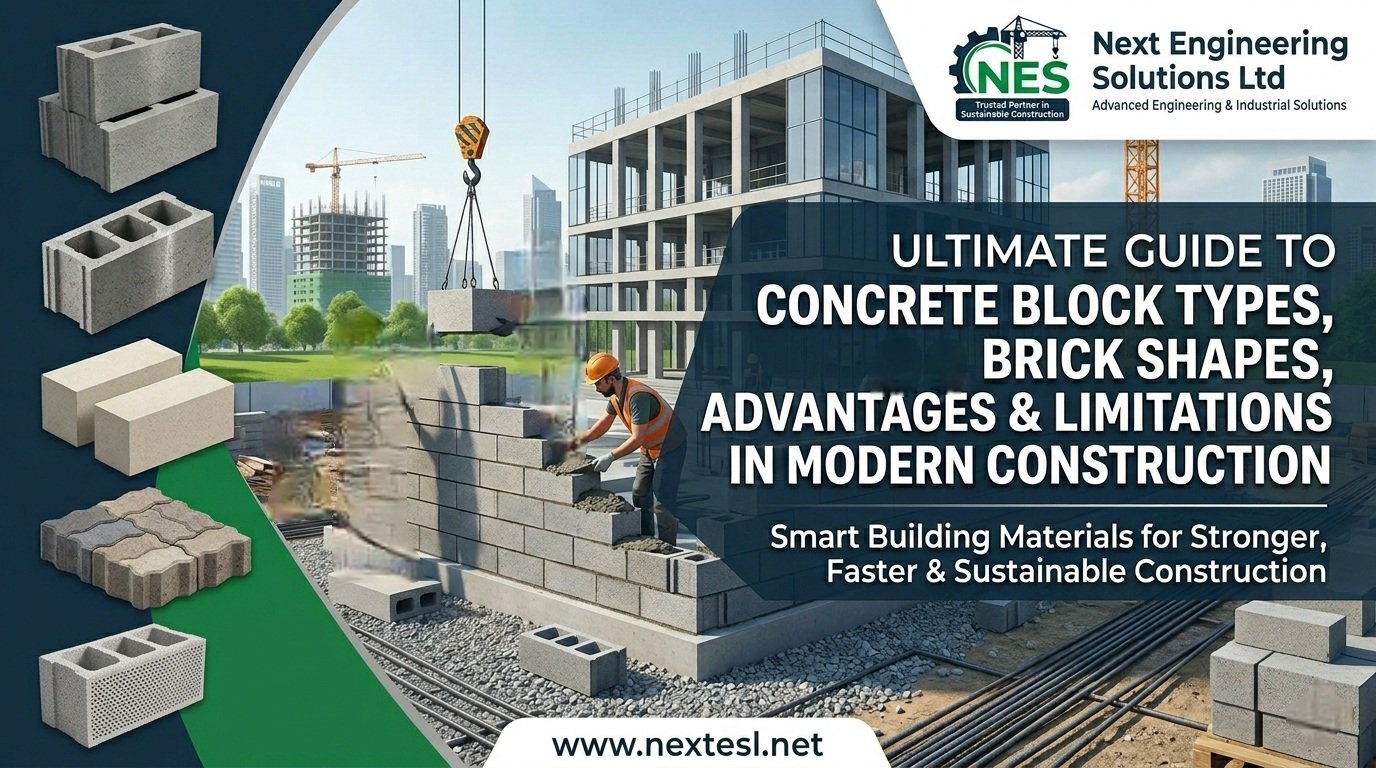
Top 7 Types of Concrete Blocks in Modern Construction
1. Solid Concrete Blocks
Dense and heavy, these units provide maximum compressive strength.
- Composition: Cement, sand, and heavy aggregates (crushed stone).
- Best For: Foundations, basements, and heavy load-bearing industrial walls.
- Advantages: High durability and superior sound insulation.
- Limitations: Heavy weight increases the building’s dead load and transportation costs.
2. Hollow Concrete Blocks
These contain voids (cores) that occupy more than 25% of their volume.
- Composition: Cement, sand, and stone dust.
- Best For: Multi-story buildings and residential partition walls.
- Advantages: The voids allow for rebar and grout reinforcement; lighter and faster to install than solid blocks.
- Limitations: Lower compressive strength compared to solid units.
3. AAC Blocks (Autoclaved Aerated Concrete)
A lightweight “green” material produced using a chemical foaming agent.
- Composition: Cement, lime, fly ash/silica sand, gypsum, and aluminum powder.
- Best For: Energy-efficient apartments and commercial high-rises.
- Advantages: Exceptional thermal insulation and fire resistance; reduces building weight by up to 30%.
- Limitations: Higher initial material cost and requires specific adhesives.
4. Paving Blocks (Interlocking Blocks)
Specifically designed for horizontal surfaces and heavy wear.
- Composition: High-strength cement, fine sand, and color pigments.
- Best For: Driveways, parking lots, and walkways.
- Advantages: Aesthetic variety and easy individual block replacement.
- Limitations: Requires a perfectly compacted base to prevent sinking.
5. CLC Blocks (Cellular Lightweight Concrete)
Similar to AAC but produced through a mechanical foaming process.
- Best For: Internal partitions and soundproofing.
- Advantages: Eco-friendly and extremely buoyant (floats in water).
- Limitations: Not suitable for heavy load-bearing structural elements.
6. Lintel / Channel Blocks
U-shaped blocks designed for structural support.
- Best For: Creating reinforced concrete beams over doors and windows.
- Advantages: Eliminates the need for separate formwork, speeding up construction.
7. Concrete Bricks
Small, rectangular units used for traditional masonry aesthetics with concrete strength.
- Best For: Fences, facades, and small-scale walls.
Advantages of Concrete Blocks
Concrete blocks offer several benefits that make them ideal for modern construction projects.
High Strength and Durability
Concrete blocks provide excellent structural strength and long-term performance.
Faster Construction
Larger block size reduces construction time and labor requirements.
Fire Resistance
Concrete blocks improve building safety with excellent fire-resistant properties.
Better Thermal and Sound Insulation
Hollow and lightweight blocks improve indoor comfort and energy efficiency.
Eco-Friendly Construction
Many modern concrete blocks use recycled materials and sustainable manufacturing processes.
Cost Efficiency
Reduced labor and faster installation help lower overall project costs.
Which Concrete Block Shape Is the Best?
The best concrete block shape depends on the construction purpose:
| Concrete Block Shape | Best For | Main Advantage | Popularity |
|---|---|---|---|
| 🧱 Hollow Block | Residential & commercial walls | Lightweight & faster construction | ⭐ Most Popular |
| 🏗️ Solid Block | Heavy load-bearing structures | High strength & durability | ⭐ Highly Durable |
| 🔗 Interlocking Block | Eco-friendly & rapid construction | Less mortar & faster installation | ⭐ Fast Growing |
| 📐 Stretcher Block | Straight wall masonry | Easy alignment & workable design | ⭐ Most Workable |
| 🏠 Corner Block | Wall corners & finishing | Clean edges & better appearance | ⭐ Essential |
| 🚶 Paving Block | Roads, parking & walkways | Attractive & heavy-load resistant | ⭐ Widely Used |
General Limitations of Concrete Blocks
Despite their advantages, concrete blocks also have some overall limitations:
- Some blocks absorb moisture if not properly cured
- Solid blocks increase dead load on structures
- Skilled labor is required for proper installation
- Surface finishing is often necessary for better appearance
- Poor-quality blocks may develop shrinkage cracks
Concrete Blocks vs Traditional Clay Bricks
| Feature | Concrete Blocks | Clay Bricks |
|---|---|---|
| Size | Larger | Smaller |
| Construction Speed | Faster | Slower |
| Strength | High | Moderate |
| Thermal Insulation | Better | Moderate |
| Labor Requirement | Lower | Higher |
| Cost Efficiency | More economical for large projects | Suitable for small projects |
Choosing the Right Block for Your Project
The selection of concrete blocks depends on several factors:
- Structural requirements
- Budget
- Building height
- Thermal insulation needs
- Climate conditions
- Construction speed
For industrial and load-bearing structures, solid concrete blocks are preferred. For energy-efficient and lightweight construction, AAC blocks and hollow blocks are more suitable.
Future of Concrete Block Technology
Modern construction is moving toward sustainable and energy-efficient materials. New concrete block technologies focus on:
- Lightweight construction
- Reduced carbon emissions
- Improved insulation performance
- Automated production systems
- Eco-friendly manufacturing
Concrete blocks are expected to remain one of the most important construction materials for future infrastructure development.
Final Thoughts
Concrete blocks and specially shaped bricks have transformed modern construction through better strength, faster installation, and improved efficiency. Different types of blocks and brick shapes serve unique structural and architectural purposes.
Although these materials have some limitations, their advantages make them highly suitable for residential, commercial, and industrial construction projects worldwide.
Choosing the right block type and brick shape helps improve construction quality, reduce maintenance costs, and ensure long-lasting structural performance.
🤝 Why Partner with Next Engineering Solutions Ltd (NES)?
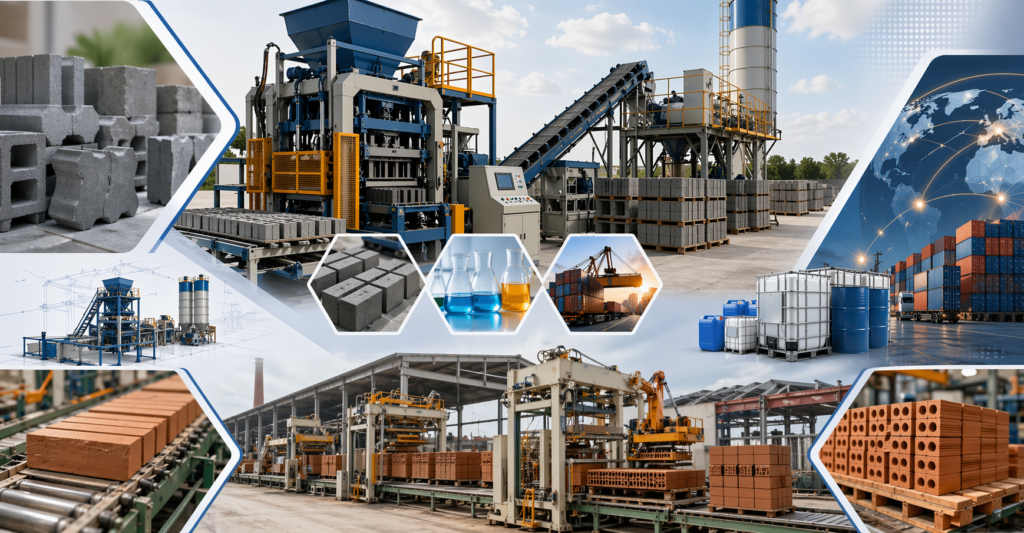
At Next Engineering Solutions Ltd, we provide the technology and expertise required to set up modern block and brick manufacturing plants.
- ⚙️ Advanced Engineering: Modern manufacturing solutions for Auto Bricks.
- 🔥 Sustainable Tech: Energy-efficient Tunnel Kiln and Single Layer Dryer systems.
- 📊 Consultancy: Industrial plant layout and process flow optimization.
Ready to modernize your construction project or manufacturing plant? Visit us at www.nextesl.net to explore our engineering solutions.
About this NES engineering article
Published by: Next Engineering Solutions Ltd — Engineering Content Team.
Technical review lead: Oashim Khan, Chief Engineer. Relevant NES specialists contribute to plant design, machinery, kiln, dryer and project-execution topics.
Meet the contributors and read the NES technical review policy.