NES Engineering Guide · Automatic Clay Brick Manufacturing
Automatic Tunnel Kiln & Tunnel Dryer Clay Brick Plant: Complete Guide for 50K-240K Bricks/Day
A practical guide to production flow, corrected plant capacities, kiln and dryer operation, automation, heat recovery and project selection for modern clay brick manufacturing.
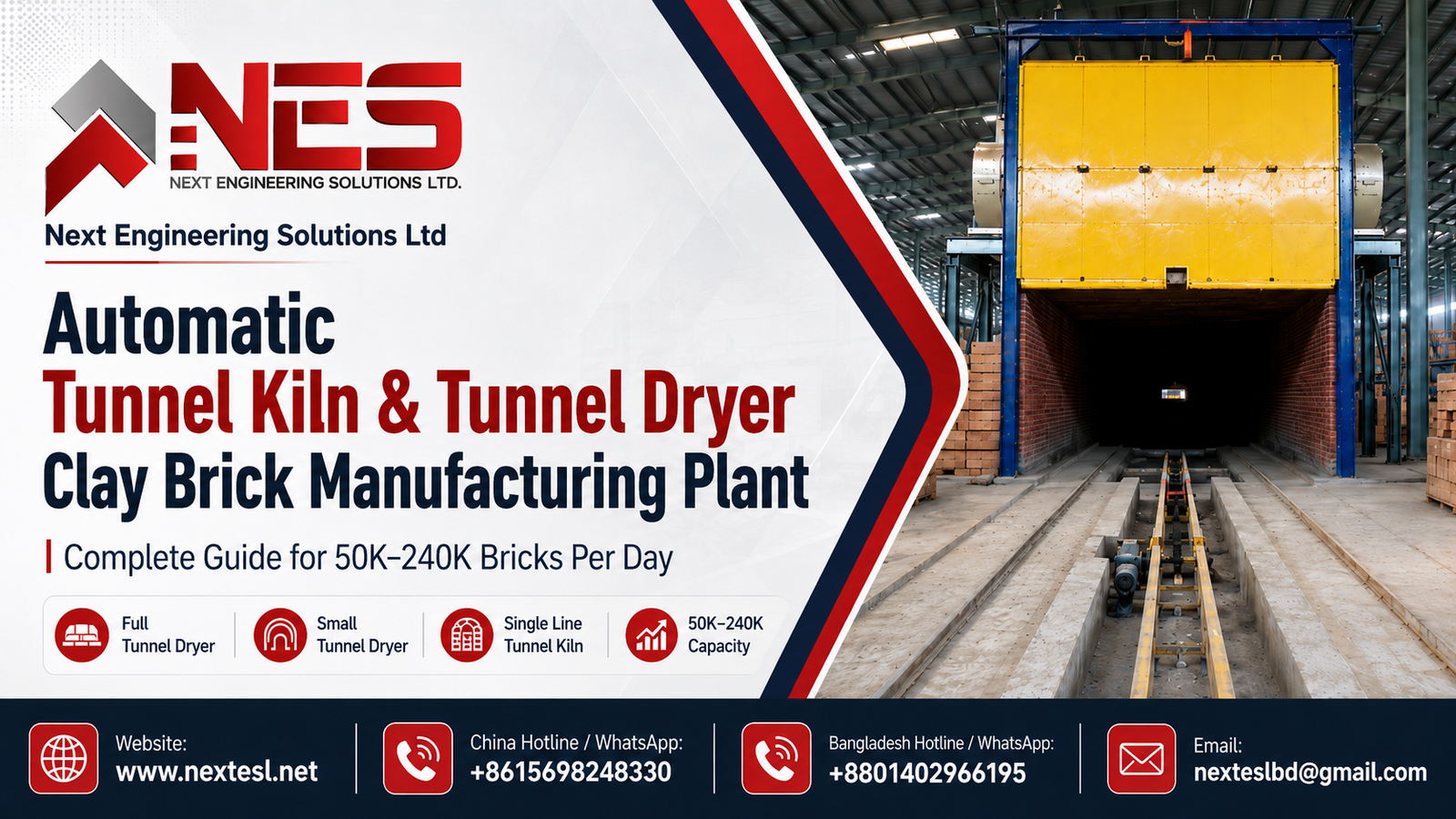
Article synopsis: This guide explains how a complete automatic tunnel kiln and tunnel dryer clay brick plant works from raw-material preparation and vacuum extrusion to controlled drying, firing, cooling and finished-brick handling. It also compares four practical NES planning configurations: 50,000-70,000, 100,000-120,000, 120,000-140,000 and 200,000-240,000 bricks per day.
Article quick navigation
Engineering note: The capacities in this article are planning ranges, not guaranteed outputs. Final production depends on fired brick size and weight, clay characteristics, moisture, drying sensitivity, kiln-car loading density, firing cycle, fuel, product mix, operating stability and local climate. Clay testing and project-specific thermal calculations must be completed before the kiln, dryer and machinery package is finalized.
Why Tunnel Kiln Technology Is Used for Industrial Clay Brick Production
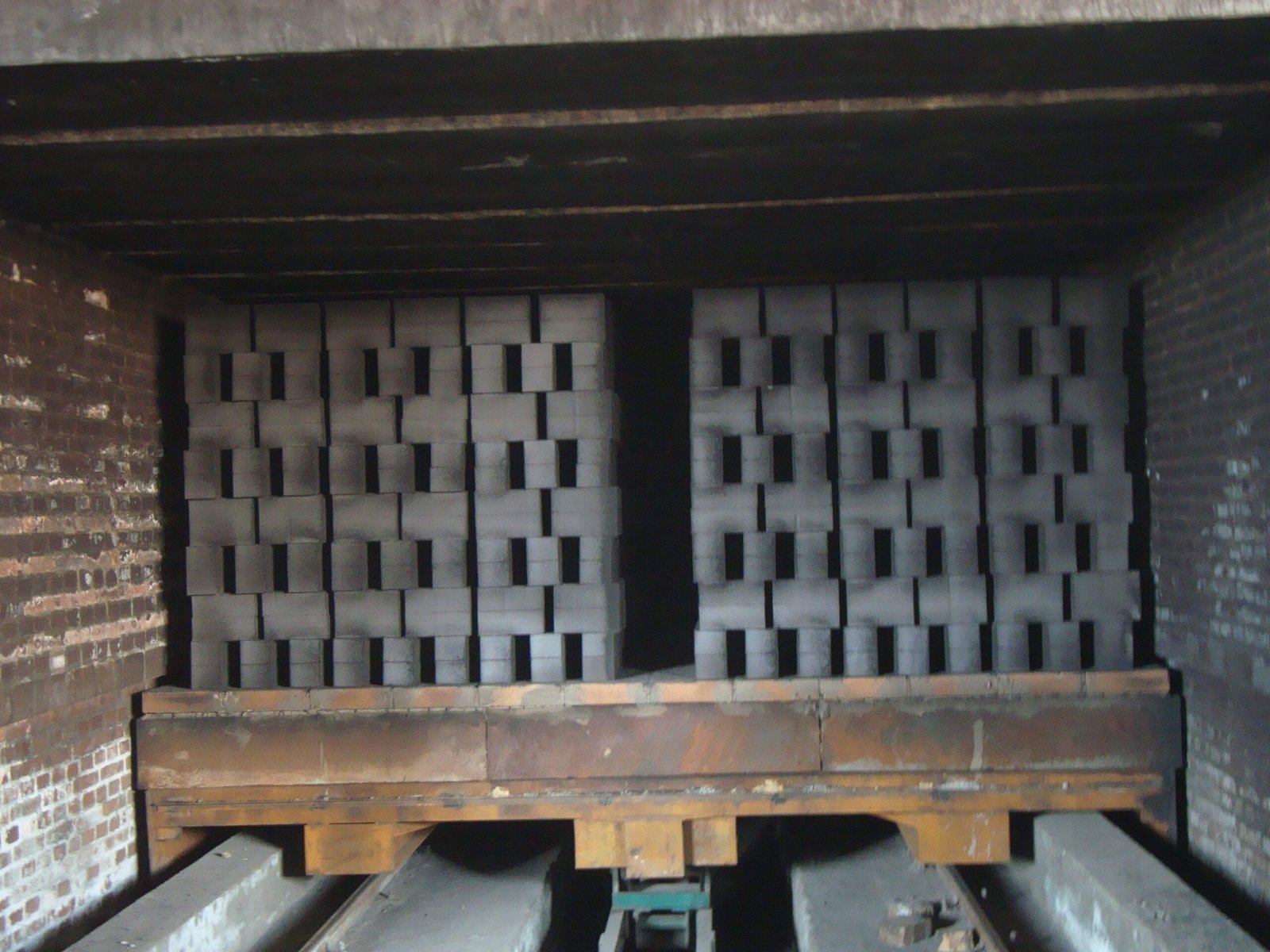
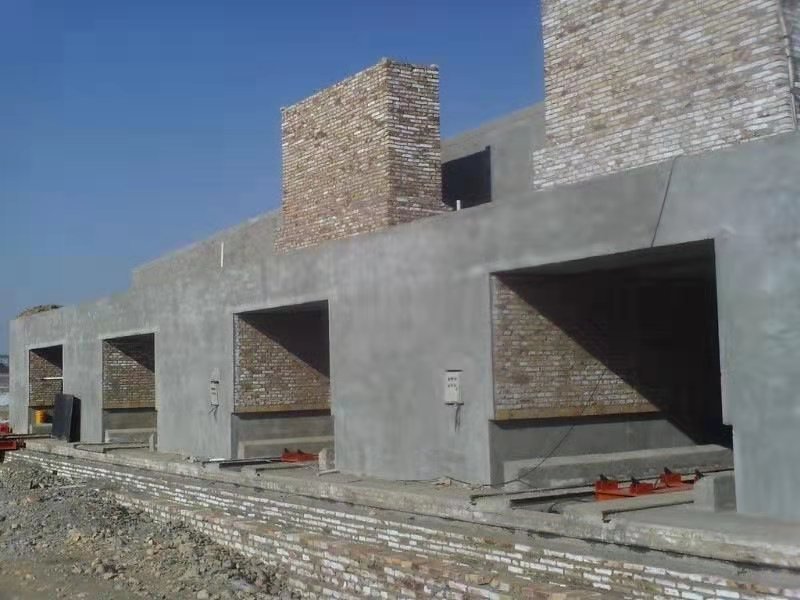
An automatic tunnel kiln and tunnel dryer clay brick plant is a continuous manufacturing system in which the brick setting travels through controlled thermal zones while the kiln structure remains stationary. After green bricks are formed and dried, kiln cars carry them through preheating, firing and cooling. Temperature, pressure, airflow, fuel feeding and car movement are coordinated to produce a repeatable firing curve.
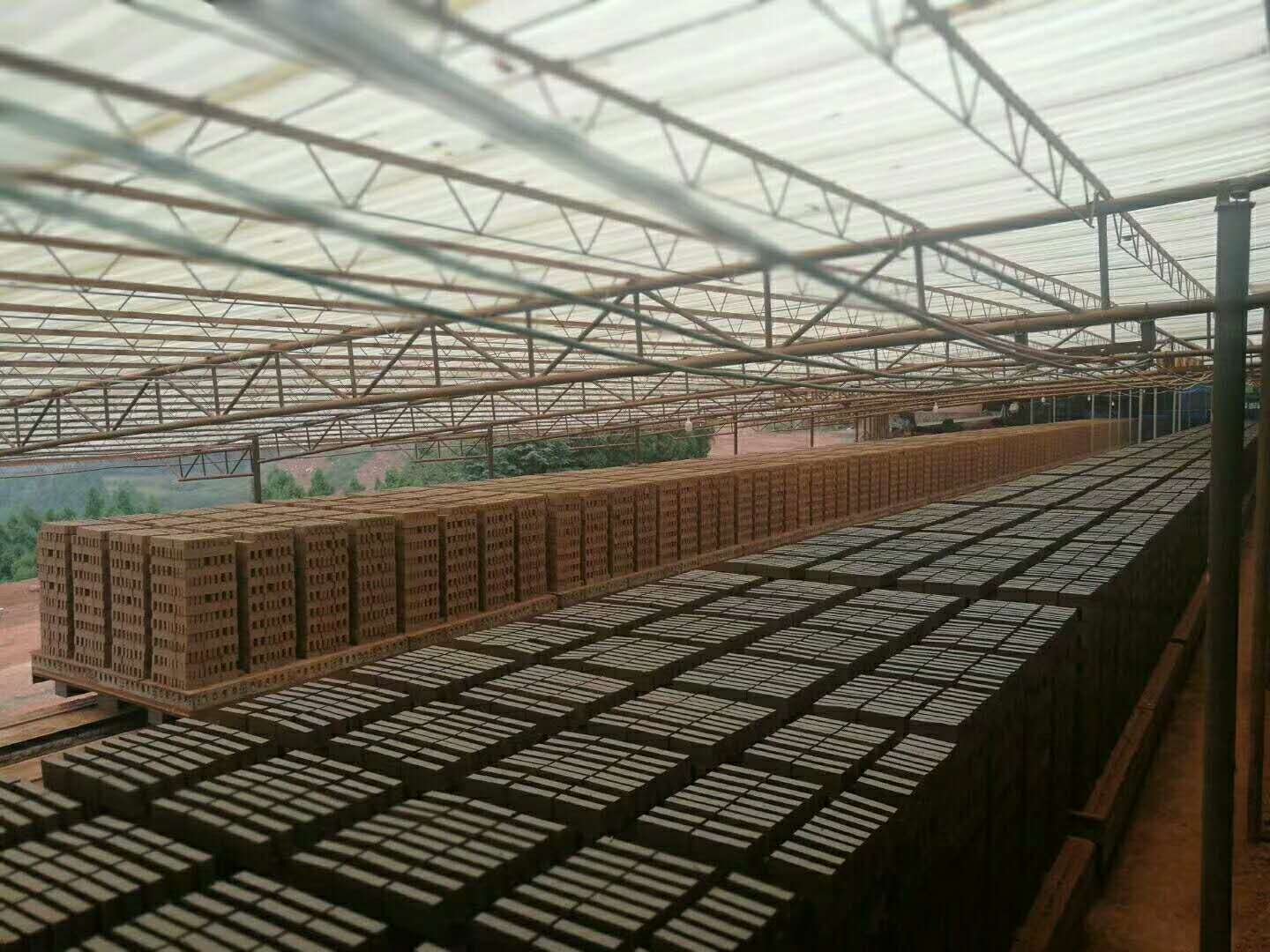
The tunnel dryer is equally important. Freshly extruded green bricks contain moisture and cannot safely enter the kiln without controlled drying. If moisture is removed too quickly, the bricks may crack, bend or collapse; if they remain wet, they can burst or require excessive energy during firing. A correctly designed dryer gradually manages temperature, humidity and airflow according to the clay’s drying behaviour.
Compared with conventional seasonal brick production, a well-designed tunnel kiln and dryer system offers greater potential for automation, process control and consistent output. The actual commercial advantage, however, depends on good raw material, correct engineering, trained operators, preventive maintenance, suitable fuel and stable market demand. No kiln technology can compensate for an unsuitable clay body or an unbalanced production line.
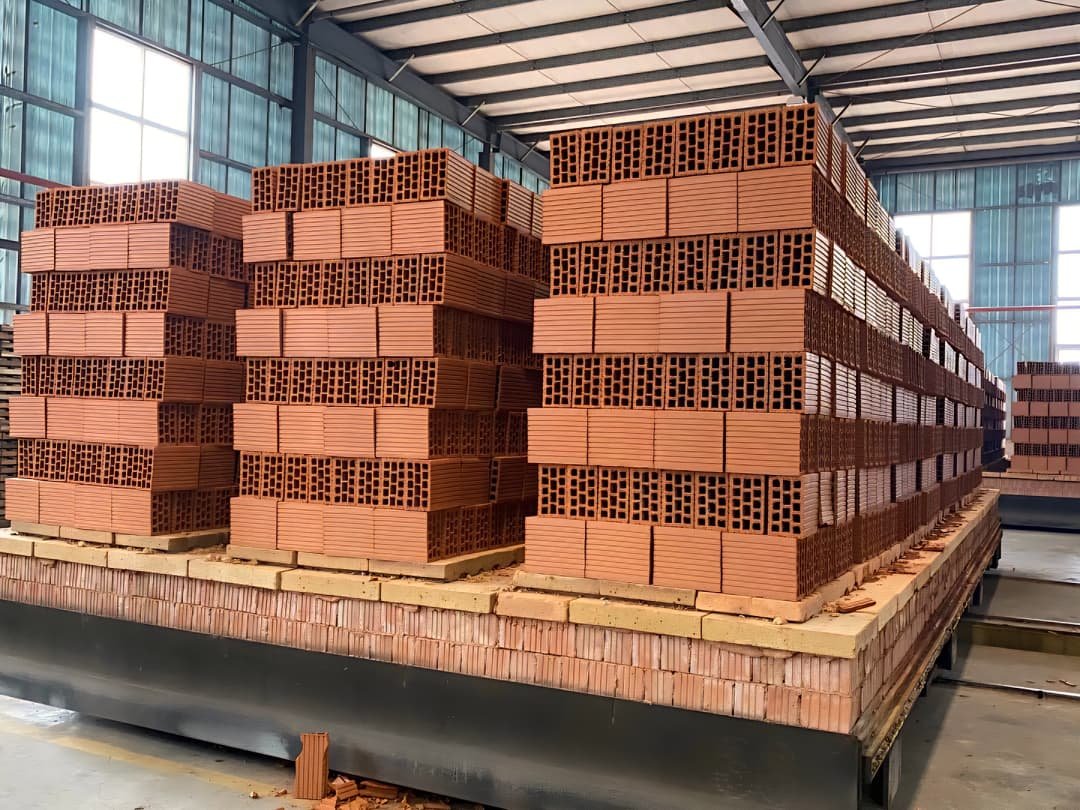
How the Tunnel Dryer and Tunnel Kiln Work Together
The tunnel dryer and kiln perform different operations but must be thermally and mechanically matched. The dryer uses controlled circulation to remove water from green bricks. The kiln then raises the dried bricks through the required preheating and firing curve before controlled cooling.
Tunnel dryer control
The dryer should follow a controlled drying curve. Early drying is normally gentle because the green brick is wet and mechanically weak. Moisture removal can increase through the middle zones, while the final zone reduces residual moisture before firing. Air circulation, exhaust, humidity, temperature, residence time and the brick-setting pattern must work together.
Tunnel kiln control
The kiln normally contains preheating, firing and cooling zones. A coordinated draught system manages combustion air, pressure and exhaust gas. The firing temperature and residence time are determined by the clay body and required product—not by a single universal setting. Correct cooling protects the fired brick and provides recoverable thermal energy.
Important distinction: Kiln length equals dryer length is a common project arrangement, but equal physical length alone does not prove equal capacity. The design must also match usable cross-section, car spacing, loading density, residence time, airflow, moisture load and heat availability.
Tunnel Kiln Plant Capacity Guide: 50,000-240,000 Bricks Per Day
The following planning configurations provide a consistent basis for preliminary project discussion. Each production range is linked to a clear tunnel kiln and tunnel dryer arrangement.
3.7 m — 118 m dryer
4.6 m — 140 m dryer
| Planning capacity | Reference kiln configuration | Reference dryer configuration | System arrangement | Typical project position |
|---|---|---|---|---|
| 50,000-70,000 bricks/day | 1 — 3.7 m — 118 m tunnel kiln | 1 — 3.7 m — 118 m tunnel dryer | One matched kiln and dryer line | Entry-scale automatic plant or regional supplier with controlled demand |
| 100,000-120,000 bricks/day | 1 — 4.5 m — 140 m tunnel kiln | 1 — 4.5 m — 140 m tunnel dryer | One wider, higher-output line | Established medium-to-large producer serving a strong regional market |
| 130,000-140,000 bricks/day | 2 — 3.7 m — 118 m tunnel kilns | 2 — 3.7 m — 118 m tunnel dryers | Two matched modular lines | High-capacity project needing modular operation or phased expansion |
| 200,000-240,000 bricks/day | 2 — 4.6 m — 140 m tunnel kilns | 2 — 4.6 m — 140 m tunnel dryers | Two large industrial lines | Large-volume manufacturer with dependable raw material, utilities and sales |
These four configurations are easier to evaluate because each capacity range corresponds to one clear physical arrangement. This avoids overlapping production bands and gives investors a consistent basis for preliminary technical and commercial discussion.
50,000-70,000 bricks/day: 3.7m single-line plant
This is the practical starting configuration in the current NES range: one 3.7m — 118m tunnel kiln and one matching tunnel dryer. It can suit a regional market where the investor wants continuous industrial production without immediately installing two lines. Future expansion should be considered at the site-layout stage so that land, utility corridors, clay preparation and finished-product handling do not block a second line.
100,000-120,000 bricks/day: 4.6m single-line plant
One 4.6m — 140m kiln and dryer line offers higher output without the additional transfer and operating systems required by two smaller lines. This arrangement can simplify production management, although a planned maintenance shutdown affects the complete thermal line. It is therefore appropriate where the market can absorb roughly 100,000 bricks per day and the plant has reliable clay, fuel, electricity, spares and technical supervision.
120,000-140,000 bricks/day: two 3.7 m lines
Two 3.7m — 118m kilns with two matching dryers provide modular capacity. The two-line arrangement can support phased implementation or more flexible maintenance planning, but it also requires duplicated thermal equipment, car movement systems and operating controls. Raw-material preparation and forming capacity must be designed to supply both lines without interruption.
200,000-240,000 bricks/day: two 4.6 m industrial lines
This is the largest standard arrangement covered by the current NES reference page: two 4.6m — 140m kilns and two matching dryers. Such a project should be treated as a large industrial operation. It requires long-term clay reserves, substantial working capital, dependable fuel and electrical infrastructure, disciplined maintenance, trained personnel, sufficient covered storage and a market capable of absorbing sustained output.
Main Machinery and Plant Systems
The final equipment list depends on clay condition, production capacity, product type and automation target. A complete plant may include:
Raw-material preparation
- Clay stockyard and blending system
- Box feeders and controlled batching
- Primary and fine crushing equipment
- Screening or impurity removal where required
- Double-shaft mixing and water dosing
- Aging storage and material reclaiming
Forming and handling
- Fine mixing or extrusion mixing
- Vacuum extruder and product die
- Automatic strip and brick cutting
- Conveyors and green-brick grouping
- Automatic setting machine or robot system
- Manual or automatic fired-brick unloading
Dryer and kiln systems
- Tunnel dryer with circulation and exhaust fans
- Tunnel kiln with preheating, firing and cooling zones
- Kiln cars, seals, tracks and refractory setting
- Fuel preparation, feeding and combustion equipment
- Heat-recovery ducting and temperature controls
- Flue-gas handling and required emission controls
Movement, utilities and controls
- Hydraulic pushers and ferry-transfer systems
- Electrical distribution and motor-control centres
- PLC, instruments, interlocks and operator controls
- Compressed air, water and workshop utilities
- Laboratory and production-quality equipment
- Safety, maintenance and emergency systems
A high-capacity kiln cannot achieve its target if the extruder, cutter, setting equipment, dryer, kiln cars or unloading area becomes a bottleneck. Rated machine output should therefore be checked against effective output after maintenance time, product changes, normal stoppages and expected rejection.
Heat Recovery, Automation and Environmental Control
Recovering useful heat
Hot air from the kiln cooling zone can be directed to the tunnel dryer. This reduces avoidable heat loss and can lower auxiliary energy demand. The recovery system must still control temperature, airflow and pressure; uncontrolled hot air can dry the brick surface too quickly and increase cracking.
PLC, instruments and variable-speed drives
Modern controls can monitor zone temperatures, pressure, fan status, motor loads and kiln-car movement. Variable-frequency drives help adjust fans and conveyors to process demand. Automation improves repeatability, but reliable sensors, correct control logic, trained operators and manual operating procedures remain essential.
Automatic setting and car handling
Automatic cutters, grouping systems, setting machines or robots can reduce repetitive handling and improve setting consistency. The selected system must suit brick size, green strength, product mix and the required air gaps through the brick setting. Kiln-car movement should include safe interlocks and a practical plan for car maintenance.
Flue-gas and dust control
A tunnel kiln should never be described as pollution-free. Environmental performance depends on fuel quality, firing control, raw-material chemistry, dust collection, exhaust design and the emission-control equipment required by local law. Coal-fired projects may need appropriately engineered desulfurization, dust-removal or smoke filter tower systems, while gas, biomass or mixed-fuel projects require their own safety and emission assessment.
Before investment, the project owner should confirm environmental approvals, fuel restrictions, stack requirements, monitoring obligations, wastewater or residue handling and occupational-safety rules with the responsible local authorities. Equipment must be designed for the actual regulatory limit not a generic marketing target.
Advantages and the Conditions Required to Achieve Them
| Potential advantage | What makes it possible | What can reduce the benefit |
|---|---|---|
| More consistent brick quality | Stable clay preparation, setting pattern, airflow and firing curve | Variable clay, poor mixing, wet bricks or unstable fuel feeding |
| Lower manual handling | Automatic cutting, setting, car movement and unloading where justified | Fragile green bricks, unsuitable layouts or poorly supported automation |
| Better thermal efficiency | Effective insulation, combustion control, heat recovery and preventive maintenance | Air leakage, damaged seals, poor car condition or incorrect kiln pressure |
| Continuous planned production | Covered material handling, stable utilities, spares and trained operation | Rain-affected clay, power interruption, fuel shortage or sales constraints |
| Scalable industrial capacity | Master planning for future lines and appropriately sized shared systems | Insufficient land, undersized preparation equipment or blocked logistics |
Tunnel kiln technology may offer stronger automation and capacity potential than many traditional kiln systems, but it should not automatically be presented as the lowest-cost choice for every project. Capital cost, financing, raw-material risk, fuel price, power quality, labour cost, utilization rate and maintenance capability must all be included in a project-specific feasibility study.
Complete Tunnel Kiln Clay Brick Product Flow
A tunnel kiln clay brick manufacturing plant is a connected process from clay receiving to finished-brick dispatch. Each stage must deliver the correct material condition and quantity to the next stage. A problem in crushing, moisture control, extrusion or setting can later appear as dryer cracking, kiln rejection, colour variation or reduced production.
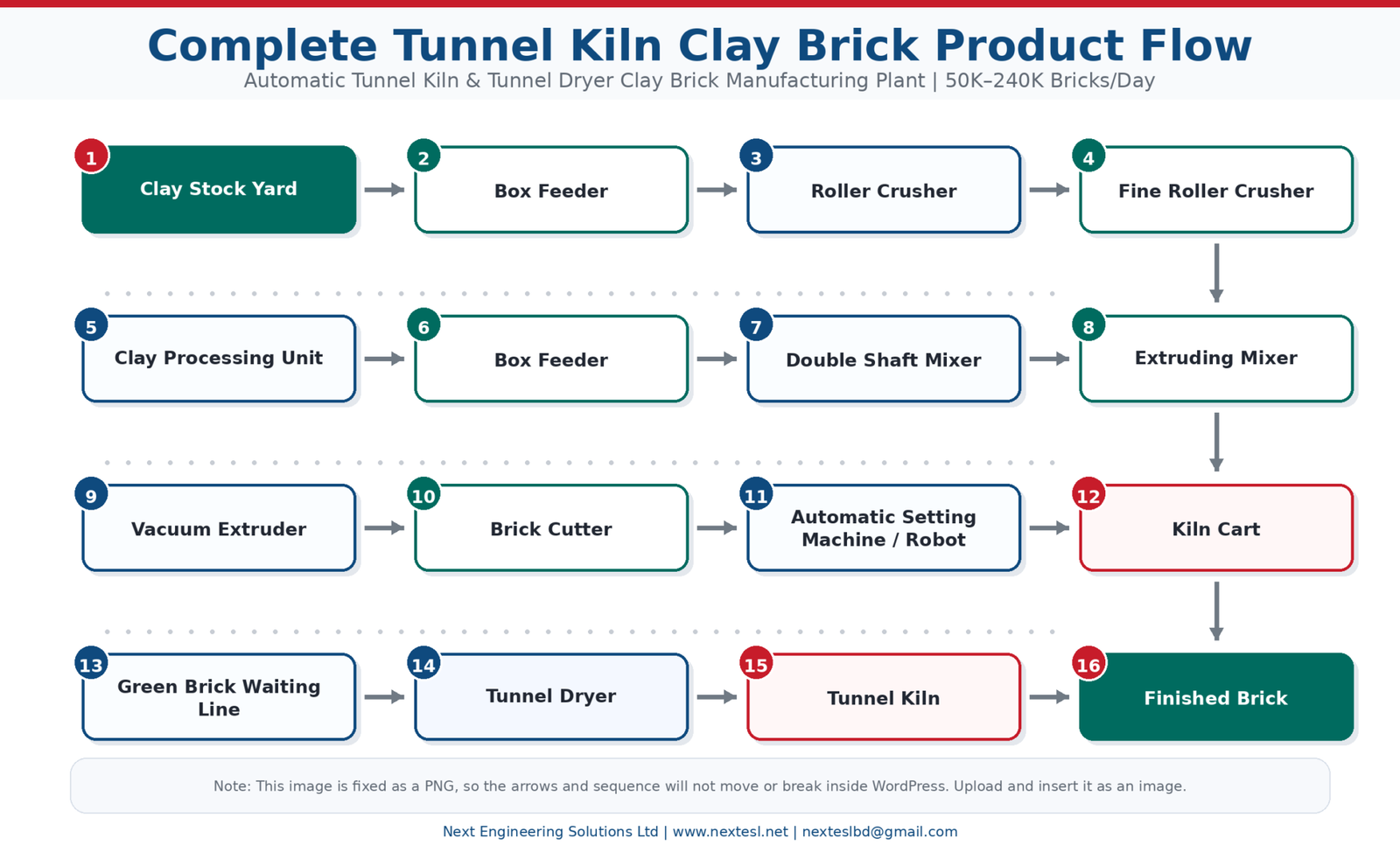
Quality control must begin before extrusion, not after firing. Clay composition, particle size, mixing uniformity, extrusion vacuum, green-brick strength, dimensional accuracy and the setting pattern all influence dryer and kiln performance. For deeper troubleshooting guidance, see NES article on green brick drying problems in tunnel dryers.
Process control data sheet
| Production stage | Main systems | Critical control points | Required stage output |
|---|---|---|---|
| Clay preparation | Stockyard, box feeder, crushers, mixer and aging storage | Clay blending, impurity control, particle size, moisture and aging time | Uniform and workable clay body for forming |
| Forming & cutting | Fine mixer, vacuum extruder, die, strip cutter and brick cutter | Extrusion moisture, vacuum, pressure, shape and dimensional accuracy | Strong and consistently sized green bricks |
| Setting & car loading | Conveyors, grouping system, setting machine or robot and cars | Green strength, stable handling, setting density and airflow gaps | Secure and repeatable loading pattern |
| Tunnel drying | Dryer, circulation fans, exhaust, ducting and heat-recovery system | Temperature, humidity, airflow, residence time and final moisture | Evenly dried bricks without cracks, collapse or a wet core |
| Firing & cooling | Tunnel kiln, fuel system, draught fans, instruments and kiln cars | Firing curve, pressure, combustion, soaking and controlled cooling | Fired bricks with the specified colour, shape and strength |
| Unloading & dispatch | Unloading, sorting, stacking, packing and finished-goods storage | Visual grading, dimensions, strength sampling, rejection and traceability | Market-ready bricks classified for delivery |
How to Select the Right Plant Capacity
- Test the raw material. Determine particle distribution, plasticity, moisture demand, drying shrinkage, firing shrinkage, sensitivity, fired colour, strength and suitable temperature range.
- Define the product. Confirm the fired dimensions and weight of solid, perforated, hollow or special products. Piece count alone is not an adequate basis for kiln design.
- Validate the market. Study realistic annual sales, seasonal demand, selling price, transport radius, competitor capacity and customer preference.
- Confirm fuel and utilities. Check fuel quality, price and regulation; electrical load and reliability; water; backup power; workshop support and local spare availability.
- Prepare a master layout. Include stockyards, aging, production shed, dryer, kiln, car tracks, transfer areas, finished-brick storage, roads, drainage, offices, utilities and future expansion.
- Balance each process. Clay preparation, extrusion, cutting, setting, drying, firing, unloading and packing must all support the required effective output.
- Complete the financial model. Evaluate project cost, working capital, ramp-up, utilization, rejection, maintenance, fuel, electricity, labour, finance and logistics under conservative assumptions.
Information required for preliminary project planning: location, target daily capacity, fired brick size and weight, product type, clay source and test report, land dimensions, local climate, fuel, available electrical load, automation requirement, expected working days, expansion plan and budget range.
Conclusion
An automatic tunnel kiln and tunnel dryer plant is not simply a larger kiln. It is a coordinated industrial system whose performance depends on clay preparation, green-brick quality, dryer control, kiln design, car loading, fuel, automation, utilities and daily management.
For current NES planning, the clear reference range is 50,000-240,000 bricks per day: one 3.7 m line for 50K-70K/day, one 4.6 m line for 100K-120K/day, two 3.7 m lines for 120K-140K/day, or two 4.6 m lines for 200K-240K/day. Final dimensions and output must be confirmed from the actual brick, clay, climate and operating design.
Why These Projects Matter in South Asia, Central Asia and Other Asian Markets
Asia contains diverse brick markets, climates, fuel systems and regulatory conditions. The same standard plant should not be copied from one country to another without adaptation. Tunnel kiln and tunnel dryer projects are especially relevant where investors need repeatable quality, controlled production and larger organized supply—but the engineering must respond to local realities.
South Asia: India, Bangladesh and Nepal
In India, Bangladesh and Nepal, fired clay brick remains important to housing, urban expansion, factories and infrastructure supply chains. Many producers also face seasonal rain, rising labour difficulty, variable fuel cost and increasing environmental scrutiny. A covered, mechanically prepared and thermally controlled plant can improve production planning and reduce dependence on open-air drying. The dryer must be designed for monsoon humidity, local clay sensitivity and the intended brick format, while fuel and emission systems must satisfy the rules of the specific state, province or country.
Central Asia
Central Asian projects may operate through cold winters, dry summers and large temperature changes. Controlled tunnel drying can support more predictable operation than exposed drying, while recovered kiln heat can be valuable in colder periods. Buildings, insulation, water systems, fuel selection, refractory specification and automation components must be suitable for winter conditions and local service capability.
Other Asian markets
Across Southeast Asia, East Asia, the Middle East and other Asian regions, project needs vary from humid coastal climates to hot, dusty or fuel-constrained locations. Modular capacity options allow the investor to match the system to demand rather than oversize the plant. The strongest projects combine local clay testing, reliable energy, efficient logistics, trained operators, suitable environmental control and a realistic route to market.
Why the technology is suitable: a correctly engineered tunnel kiln and dryer can integrate continuous thermal processing, kiln-car handling, automatic forming and setting, controlled moisture removal, heat recovery and data-based operation. These features are valuable in markets seeking a transition from seasonal production to dependable industrial supply. Suitability must still be demonstrated through a country-specific technical, environmental and financial study.
Plan Your Tunnel Kiln & Tunnel Dryer Project with NES
Next Engineering Solutions Ltd supports automatic clay brick projects with feasibility discussion, clay and product review, capacity selection, plant layout planning, machinery configuration, tunnel kiln and dryer engineering, installation guidance, commissioning coordination, training and after-sales support.
Send your project location, target production, brick size, clay information, land dimensions, fuel, available power and preferred automation level for a project-specific technical discussion.
Email: info@nextesl.net
Website: www.nextesl.net
Offices: Jinan, Shandong, China · Dhaka, Bangladesh
Published by: Next Engineering Solutions Ltd – Engineering Content Team.
Technical review: NES plant-design, machinery, kiln, dryer and project-execution specialists. Project capacities are preliminary reference ranges and require project-specific confirmation.