Complete 1.2 Lac/Day Tunnel Kiln Clay Brick Plant Layout with Small Tunnel Dryer: Design Guide & Technical Solutions
Modern clay brick manufacturing is evolving toward higher automation, lower fuel consumption, and continuous production systems. Traditional firing methods often face challenges such as inconsistent product quality, high energy costs, excessive labor dependency, and lower production efficiency.
To overcome these limitations, manufacturers increasingly adopt integrated Tunnel Kiln and Small Tunnel Dryer systems. A properly designed plant layout not only increases production capacity but also improves drying performance, heat utilization, and operational stability.
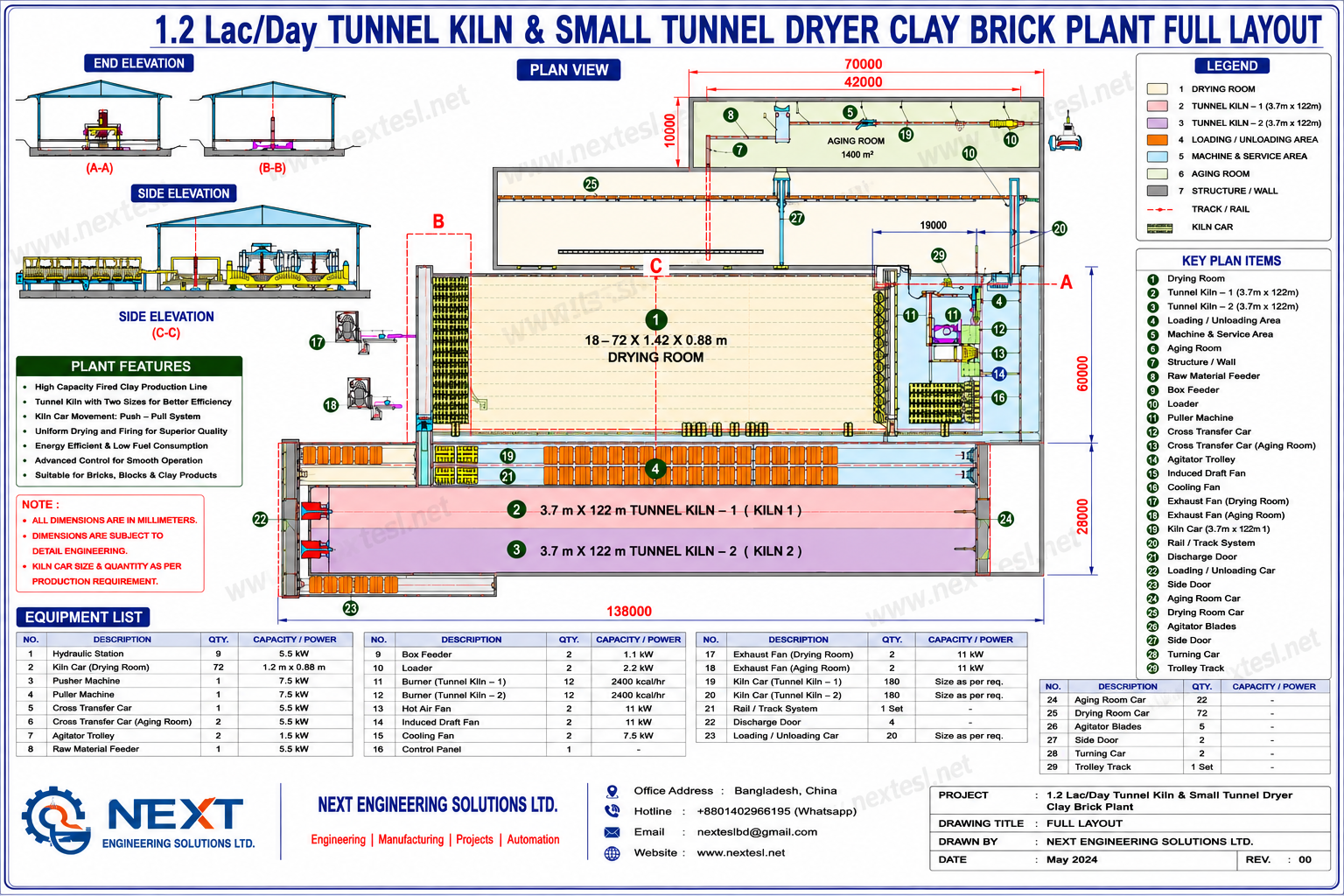
The 1.2 Lac/Day Tunnel Kiln & Small Tunnel Dryer Clay Brick Plant Full Layout is designed as a complete engineering solution for efficient clay brick production—from raw material preparation to finished brick discharge.
🏭 Understanding the Complete Plant Layout
This full plant layout combines multiple interconnected systems into a single continuous process:
✔ Raw material feeding system
✔ Aging room
✔ Drying room
✔ Small tunnel dryer
✔ Tunnel kiln firing section
✔ Kiln car transfer system
✔ Loading and unloading area
✔ Burner and combustion system
✔ Cooling section
✔ Rail and trolley movement system
✔ Machine and service area
The integrated design aims to achieve approximately 1.2 Lac bricks/day production capacity while ensuring product consistency and optimized fuel consumption.
🔄 Process Flow of the Tunnel Kiln & Dryer Plant
1. Raw Material Preparation and Aging
The process begins with clay preparation through crushing, mixing, moisture control, and aging.
The purpose of aging:
- Improve clay plasticity
- Equalize moisture content
- Reduce internal stress
- Improve extrusion quality
- Minimize crack formation during drying
Poor aging practices frequently create uneven moisture distribution, which later results in drying defects and firing problems.
🌡️ Drying Room System: One of the Most Critical Areas
The layout includes an 18–72 × 1.42 × 0.88m Drying Room System designed for controlled moisture removal.
Drying is often the most sensitive stage because green bricks contain significant moisture before entering the firing zone.
Main engineering objectives:
- Uniform airflow distribution
- Controlled temperature increase
- Stable humidity control
- Balanced air circulation
Common drying problems:
Green Brick Cracking
Possible causes:
- Excessively rapid drying
- Uneven airflow
- Poor stacking arrangement
- Moisture imbalance
Engineering solutions:
- Install airflow balancing systems
- Use VFD-controlled circulation fans
- Improve kiln car loading design
- Optimize airflow pathways
Drying performance significantly impacts final brick quality.
♨️ Small Tunnel Dryer: Improving Heat Recovery Efficiency
A Small Tunnel Dryer improves heat recovery and reduces operational costs.
Advantages include:
- Faster drying cycle
- Lower fuel consumption
- Better moisture control
- Improved thermal efficiency
- Increased plant throughput
Many systems recover waste heat from the tunnel kiln cooling zone, creating a highly energy-efficient process.
🔥 Tunnel Kiln Design and Technical Zones
Tunnel kilns generally consist of three major sections:
Pre-heating Zone
Functions:
- Removes residual moisture
- Gradually raises product temperature
- Prevents thermal shock
Potential technical issues:
Excessive heating may create:
- Surface cracks
- Product warpage
- Internal stress
- Shape deformation
Firing Zone
The firing zone is the core heating section.
Critical engineering factors:
- Burner spacing
- Temperature uniformity
- Fuel-air ratio
- Pressure control
- Heat distribution
Common firing issues:
Improper burner arrangement can cause:
- Uneven color
- Under-fired products
- Over-fired bricks
- Strength variation
Recommended solution:
Install modulating burner control systems with temperature monitoring sensors.
Cooling Zone
Controlled cooling is equally important.
Rapid cooling may create:
- Thermal stress
- Surface cracking
- Product breakage
The cooling section should maintain gradual temperature reduction and balanced airflow.
⚙️ Kiln Car Movement System and Mechanical Challenges
This layout utilizes a push-pull kiln car system.
Major components:
- Kiln cars
- Cross transfer car
- Rail system
- Pusher machine
- Puller machine
Common operational issues:
Rail Misalignment
Effects:
- Kiln car vibration
- Mechanical wear
- Increased maintenance
Wheel Damage
Effects:
- Track failure
- Production interruption
- Alignment issues
Preventive maintenance schedules are essential.
💨 Airflow Engineering: An Often Ignored Challenge
Air movement is one of the most critical engineering factors in tunnel kiln systems.
Poor airflow may cause:
- Uneven drying
- Temperature imbalance
- Fuel wastage
- Lower brick quality
Recommended engineering solutions:
- CFD airflow simulation
- Damper control systems
- Variable frequency drives (VFD)
- Automated temperature monitoring
⚡ Energy Efficiency Opportunities
Modern tunnel kiln plants can significantly reduce energy costs through:
- Waste heat recovery systems
- Variable speed fan systems
- Burner modulation technology
- High-performance insulation
- Automated combustion control
Energy optimization directly affects plant profitability.
🤖 Automation Opportunities in Modern Brick Plants
Advanced tunnel kiln facilities increasingly integrate:
- PLC systems
- SCADA monitoring
- Temperature sensors
- Pressure monitoring
- Production dashboards
- Remote troubleshooting
Automation improves:
✔ Product consistency
✔ Fuel efficiency
✔ Process control
✔ Maintenance planning
📐 Why Plant Layout Engineering Matters
Many factories focus only on kiln capacity while overlooking layout optimization.
Poor layout design often causes:
- Material congestion
- Excess labor movement
- Heat losses
- Longer process cycles
- Difficult maintenance access
A properly engineered layout improves productivity, workflow efficiency, and long-term plant performance.
🏢 Why Choose Next Engineering Solutions Ltd (NES)?
Next Engineering Solutions Ltd (NES) provides complete engineering and technical support for modern clay brick manufacturing projects.
Our expertise includes:
- Tunnel Kiln Design
- Small Tunnel Dryer Solutions
- Plant Layout Optimization
- Equipment Manufacturing
- Automation Systems
- Engineering Consultancy
- Installation Supervision
- Technical Support
We focus on practical engineering solutions designed to improve efficiency, product quality, and long-term operational performance.
Website:
Email: nexteslbd@gmail.com
Hotline: +8801402966195 (WhatsApp)
For complete Tunnel Kiln and Dryer solutions, contact Next Engineering Solutions Ltd for technical consultation and project discussion.
About this NES engineering article
Published by: Next Engineering Solutions Ltd — Engineering Content Team.
Technical review lead: Oashim Khan, Chief Engineer. Relevant NES specialists contribute to plant design, machinery, kiln, dryer and project-execution topics.
Meet the contributors and read the NES technical review policy.