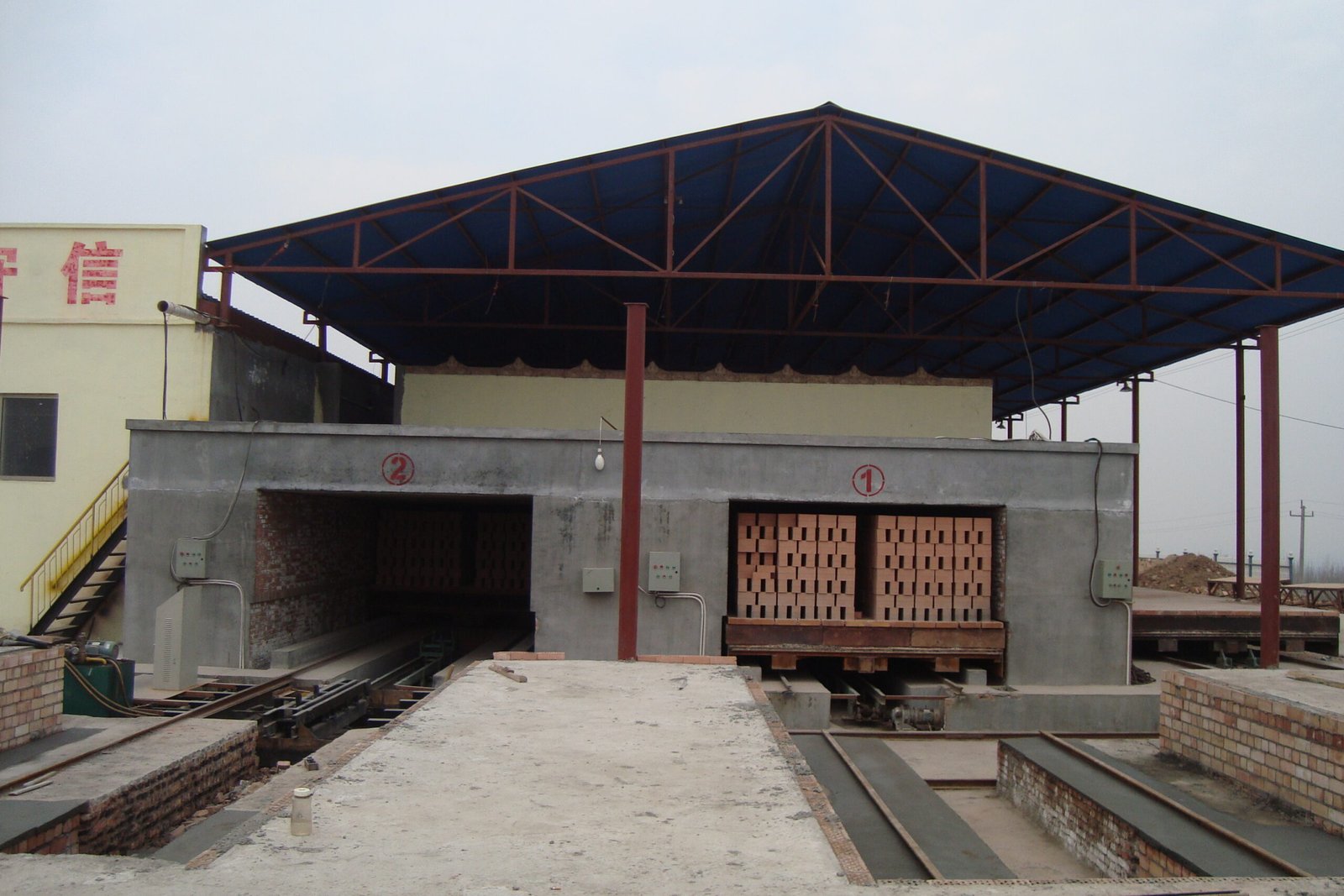
Executive perspective
Regulation is changing the investment question
The old question was, “Which kiln is cheapest to build?” The bankable question is now, “Which complete plant can secure lawful raw material, obtain location and environmental approvals, meet measured emissions, maintain saleable quality and repay its capital under realistic operating conditions?”
Across Bangladesh, India and Nepal, regulators are moving away from tolerance of uncontrolled, seasonal firing. The exact legal pathway is not identical in all three countries. Bangladesh’s finance policy explicitly recognizes Tunnel Kilns and Hybrid Hoffman Kilns (HHK) as environment-friendly brick-production investments. India’s national rules name zig-zag, vertical-shaft and piped-natural-gas pathways, while state consent conditions remain decisive. Nepal has progressively tightened chimney and emission standards and, in 2026, announced a 250 mg/Nm3 particulate limit with conversion requirements.
No kiln name creates automatic compliance. Technology approval does not replace land-use permission, environmental clearance, kiln licensing, lawful clay sourcing, approved fuel, stack testing, occupational safety or a location-specific closure order.
The new project logic
From permit to profit: five connected gates
Regulatory map
Bangladesh, India and Nepal are moving in the same direction—but by different legal routes
The following is an engineering summary, not legal advice. Project owners should obtain written confirmation from the competent national, state/provincial and local authorities.
Bangladesh example: Savar degraded airshed
The August 2025 declaration initially restricted most kiln types while naming Tunnel Kilns and HHKs as exceptions; later official statements signaled still stricter seasonal enforcement. The lesson is simple: obtain the live order before relying on a general technology category.
India example: technology wording matters
A high-quality Tunnel Kiln may outperform a poorly operated kiln, yet the national notification’s named pathways still control approval. Engineering performance and legal acceptability must both be documented.
Geology before machinery
The kiln cannot correct the wrong clay
Bangladesh and much of northern India and Nepal’s Terai are built on young alluvial systems. Two clay sources only a few kilometres apart can behave differently because river deposition changes the proportions of mica/illite, kaolinite, smectite, quartz, iron minerals, carbonates, organic matter and soluble salts.
A machinery list prepared before deposit mapping and ceramic testing reverses the correct engineering order. Raw-material behaviour should set the crusher gap, roller fineness, aging time, extrusion vacuum, green moisture, dryer curve and kiln firing schedule.
Blending plan
Preparation
Controlled drying
Firing curve
Saleable product
The British Geological Survey notes that good brick clays commonly contain kaolinite and illite, sufficient non-plastic quartz to control shrinkage and enough fluxing material for vitrification around 900–1,100°C.
Usually support workable forming and predictable ceramic development. Illitic fluxes can help vitrification, but the firing window must be tested.
Raises plasticity and water demand but can increase drying shrinkage, cracking and sensitivity to rapid humidity change.
Provide a non-plastic skeleton that can control shrinkage. Excess coarse particles may impair finish, strength or equipment life.
Commonly produce red or brown fired colour and influence vitrification. Atmosphere and peak temperature change the final shade.
Fine carbonate can act as flux; coarse limestone particles can hydrate after firing and create damaging lime pops.
Can drive efflorescence, scumming, black core, odour or higher emissions. They must be measured—not judged by colour or hand feel.
Bankable raw-material programme
What to test before choosing the kiln and extruder
Clay reserve formula
Prove tonnes and years—not only acres
= Annual saleable fired mass ÷ [saleable yield × (1 − loss on ignition)]
= Legally recoverable dry clay tonnes ÷ annual dry feed tonnes
Illustrative 100,000-brick/day case
A quick reserve stress test
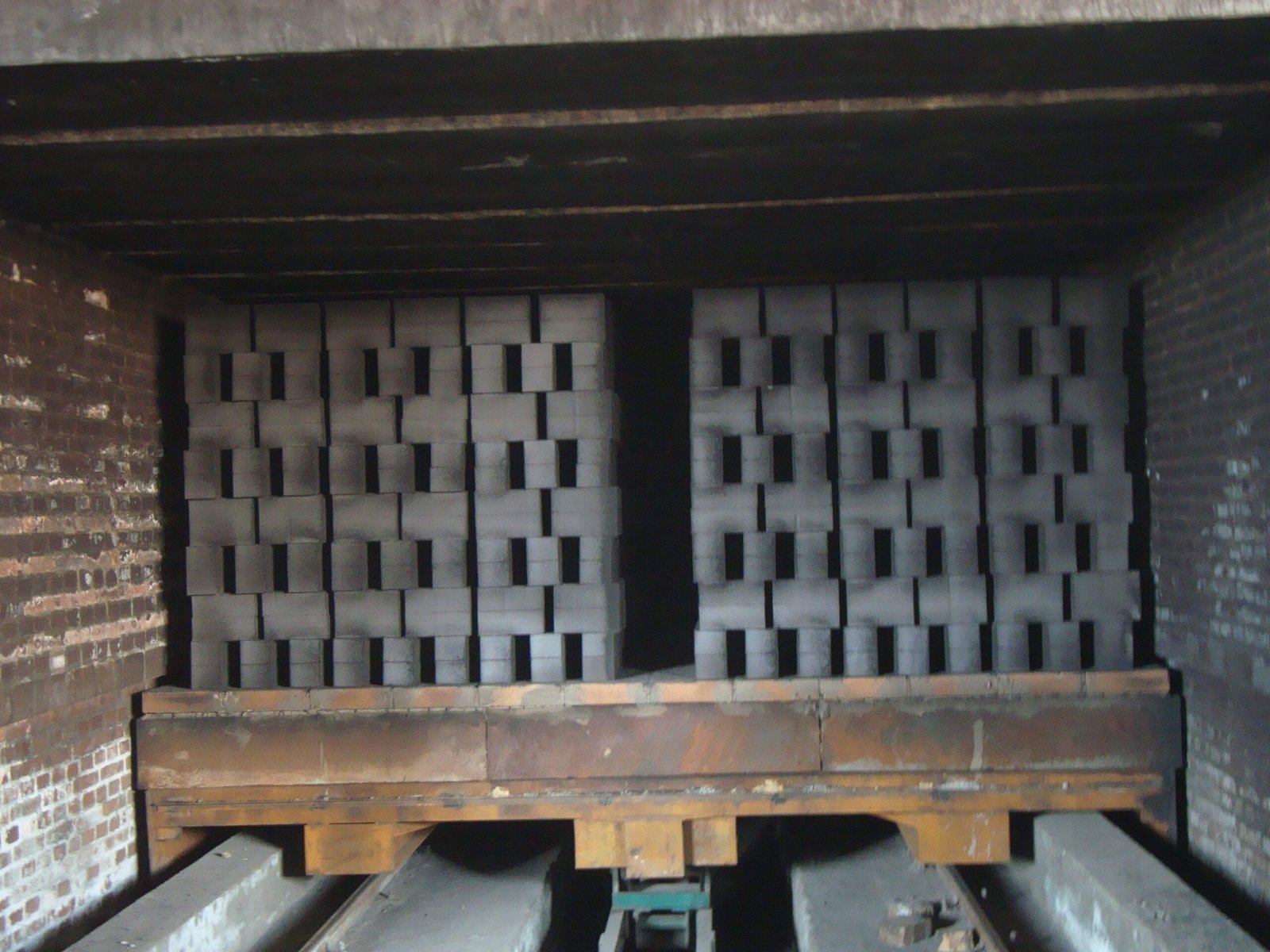
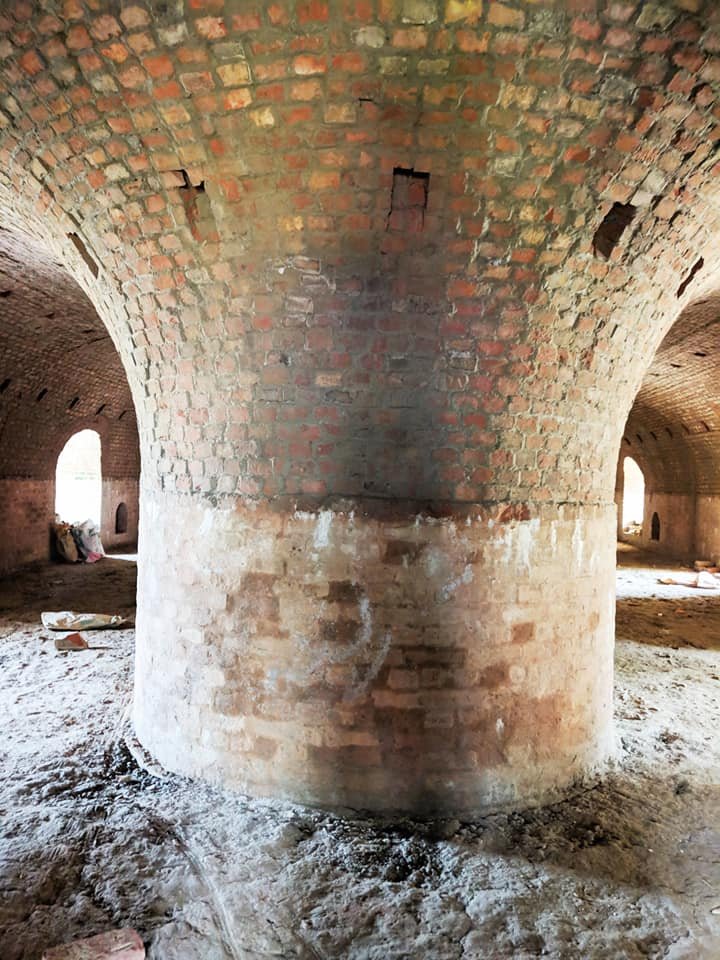
Technology selection
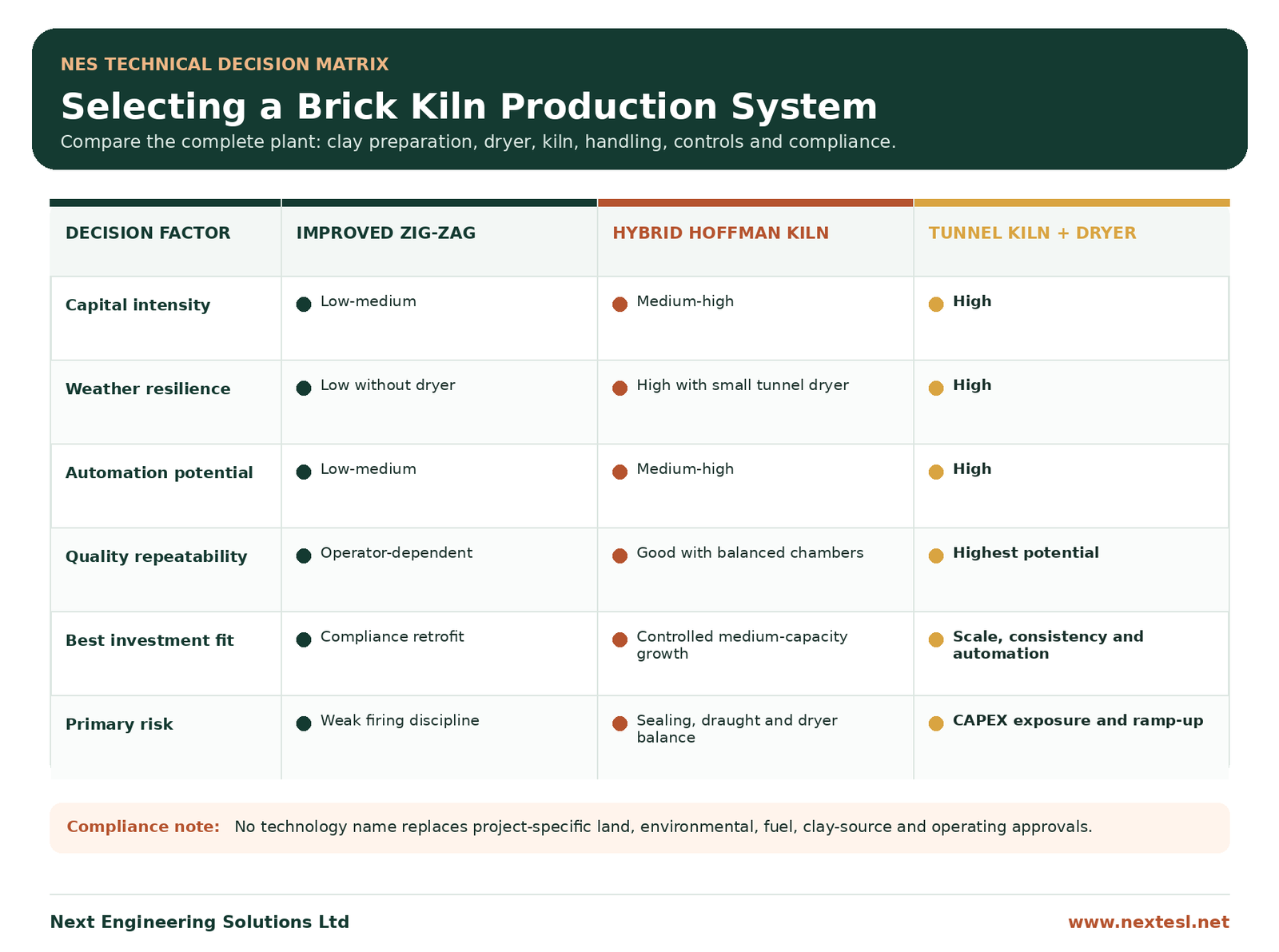
Compare the complete production system—not only the kiln shell
Published performance varies widely because clay, product weight, fuel calorific value, internal fuel, dryer load, operating skill and measurement boundary differ. A label such as “zig-zag,” “HHK” or “Tunnel Kiln” is not a guaranteed efficiency value.
Evidence, not slogans
Why “modern” does not automatically mean “lowest fuel use”
A multi-country performance assessment reported specific energy consumption of 1.22 MJ/kg fired brick for monitored FCBTKs, 1.12 MJ/kg for zig-zag kilns and 1.47 MJ/kg for one Tunnel Kiln that included dryer energy. An HHK technology brief reported about 1.2 MJ/kg. These are study observations—not design guarantees or a universal ranking.
Tunnel and HHK investments earn their advantage through controlled drying, throughput, product consistency, recoverable heat, reduced seasonal exposure and automation potential. Their fuel performance still depends on insulation, air leakage, fan control, car sealing, fuel preparation, loading density, reject rate and operator discipline.
A 2025 randomized trial in Bangladesh achieved this through low-cost operating changes such as more continuous fuel feeding and improved brick stacking. CO2 emissions fell about 20%, and brick quality improved.
A Bangladesh national strategy estimated fuel at this share of production cost in FCK and zig-zag operations. That is why metered energy per tonne—and not only coal price—belongs in every feasibility model.
Integrated engineering
A compliant kiln starts before the firing zone
Stack equipment cannot compensate for wet fuel, uncontrolled feeding, poor clay preparation, excessive green moisture or air leakage. Pollution prevention and quality control begin at raw material intake.
Clay preparation
Controlled particle size, moisture, blending and aging.
Vacuum forming
Stable density, geometry and green strength.
Controlled drying
Humidity and temperature matched to the clay’s critical moisture point.
Metered combustion
Fuel size, feed rate, oxygen and pressure controlled by zone.
Heat recovery
Cooling-zone heat routed to the dryer without destabilizing kiln pressure.
Flue-gas treatment
Cyclone/bag filter/scrubber or other system selected from measured pollutant load.
Monitoring
Stack port, platform, test records, fuel certificates and production log.
Dust & water control
Paved traffic routes, covered fuel, housekeeping, drainage and sludge management.
Financial facts
Higher CAPEX can be rational—but only when the cash-flow bridge is proven
The World Bank reported that a typical HHK could produce about 15 million bricks per year versus roughly 4 million for a fixed-chimney kiln, with around 50% lower pollution—but could cost up to 15 times more to build. That is not an instruction to buy an HHK. It is a reminder that throughput, yield and operating days must repay the capital premium.
Bangladesh Bank’s ADB-supported USD 50 million efficiency programme financed 19 subprojects; sector reporting identifies seven HHKs and twelve Tunnel Kilns. The facility’s revolving phase continued after original disbursement.
India’s central government stated in a Parliamentary answer that it did not provide kiln owners financial support to comply with the 2022 rule. State schemes, lender products and eligibility may differ.
A lender can evaluate a plant more confidently when clay tenure, permits, equipment scope, performance assumptions, buyer demand, equity, working capital and ramp-up risk are documented together.
The six numbers every feasibility model should expose
Rated output × realistic utilization × saleable yield
After discounts, transport support, tax and credit loss
Fuel + electricity, corrected for brick weight and yield
Clay, fuel, power, labour, wear parts and packing
Raw material, coal, production cycle, inventory and receivables
Interest, principal, grace period, exchange rate and downside cover
Transparent ROI framework
Calculate incremental value, not marketing payback
= fuel saving + power saving + extra saleable output + quality premium + avoided seasonal loss − added labour, maintenance and finance cost
= incremental installed cost ÷ annual incremental cash benefit
= operating cash available for debt service ÷ annual principal and interest
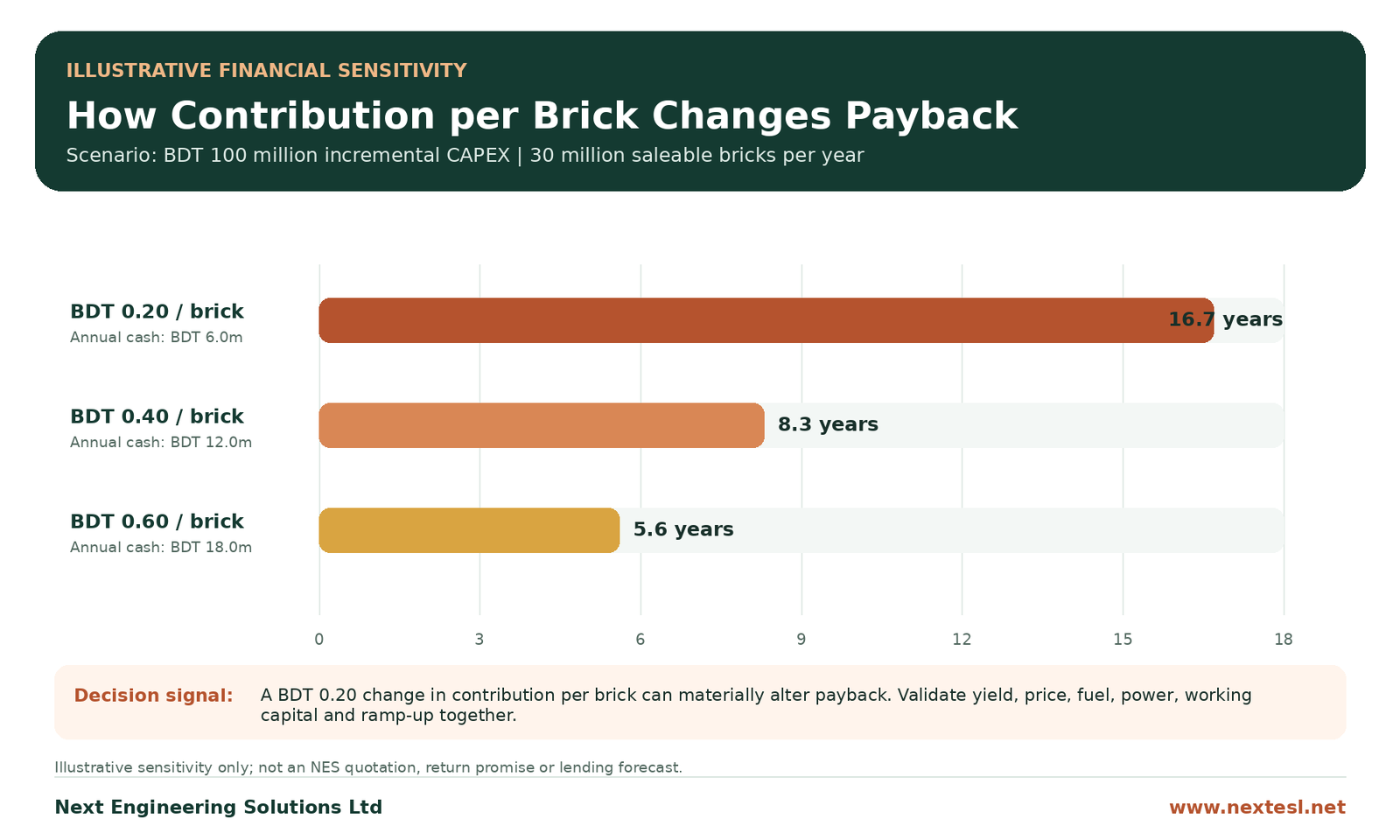
Sensitivity per BDT 100 million of incremental CAPEX
Example assumes 30 million saleable bricks/year. It shows how small changes in contribution per brick alter payback.
| Incremental benefit | Annual cash benefit | Simple payback |
|---|---|---|
| BDT 0.20/brick | BDT 6.0m | 16.7 years |
| BDT 0.40/brick | BDT 12.0m | 8.3 years |
| BDT 0.60/brick | BDT 18.0m | 5.6 years |
Fuel-saving example without inventing a coal price
If a plant currently consumes 4,800 tonnes of coal/year and verified process changes reduce use by 23%, the physical saving is 1,104 tonnes/year. Annual gross fuel saving = 1,104 × delivered coal price per tonne. Deduct added electricity, maintenance, consumables and finance cost to reach net cash benefit.
Avoid the incomplete quotation trap
The kiln price is not the project cost
A professional comparison uses the same battery limits. One offer may quote machinery ex-works; another may include refractory, kiln cars, electricals, engineering and commissioning. The lower headline price may be the higher installed cost.
Acquisition, permits, roads, drainage, water, boundary and site development
Survey, stripping, drainage, excavation, haulage, blending and covered storage
Feeding, crushing, rolling, mixing, aging, extrusion, cutting and handling
Civil, refractory, insulation, steelwork, cars, rails, fans, burners and ducting
Substation, generator, compressors, workshop, water, laboratory and firefighting
Dust control, stack access, monitoring, flue-gas treatment, wastewater and sludge
Freight, duty, insurance, installation, supervision, commissioning and training
Contingency, interest during construction, spares, ramp-up loss and working capital
Controlled growth with moderated capital
- Target output is commonly around 40,000–60,000+ bricks/day per 24–26-door system, subject to design.
- The market values conventional solid bricks and semi-automatic handling is acceptable.
- A small tunnel dryer can remove much of the seasonal drying risk.
- The project team can maintain chamber sealing, draught balance and disciplined firing.
- Written local approval accepts the proposed HHK arrangement.
Scale, consistency and automation lead
- The bankable market supports roughly 50,000–220,000+ bricks/day, depending on line configuration.
- Consistent size, colour, strength and low rejection justify process control.
- Controlled drying and year-round scheduling materially improve cash flow.
- Automatic cutting, setting, car transfer or unloading is part of the labour strategy.
- The capital plan includes ramp-up, trained operators, spares and laboratory control.
Investor checklist
Twelve questions to answer before equipment purchase
Next Engineering Solutions Ltd
Engineering the decision before engineering the plant
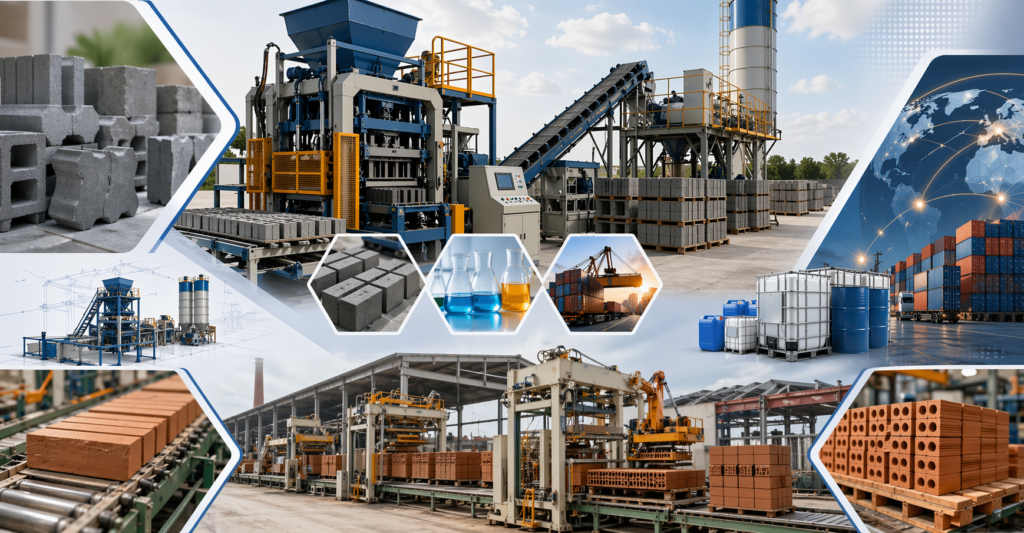
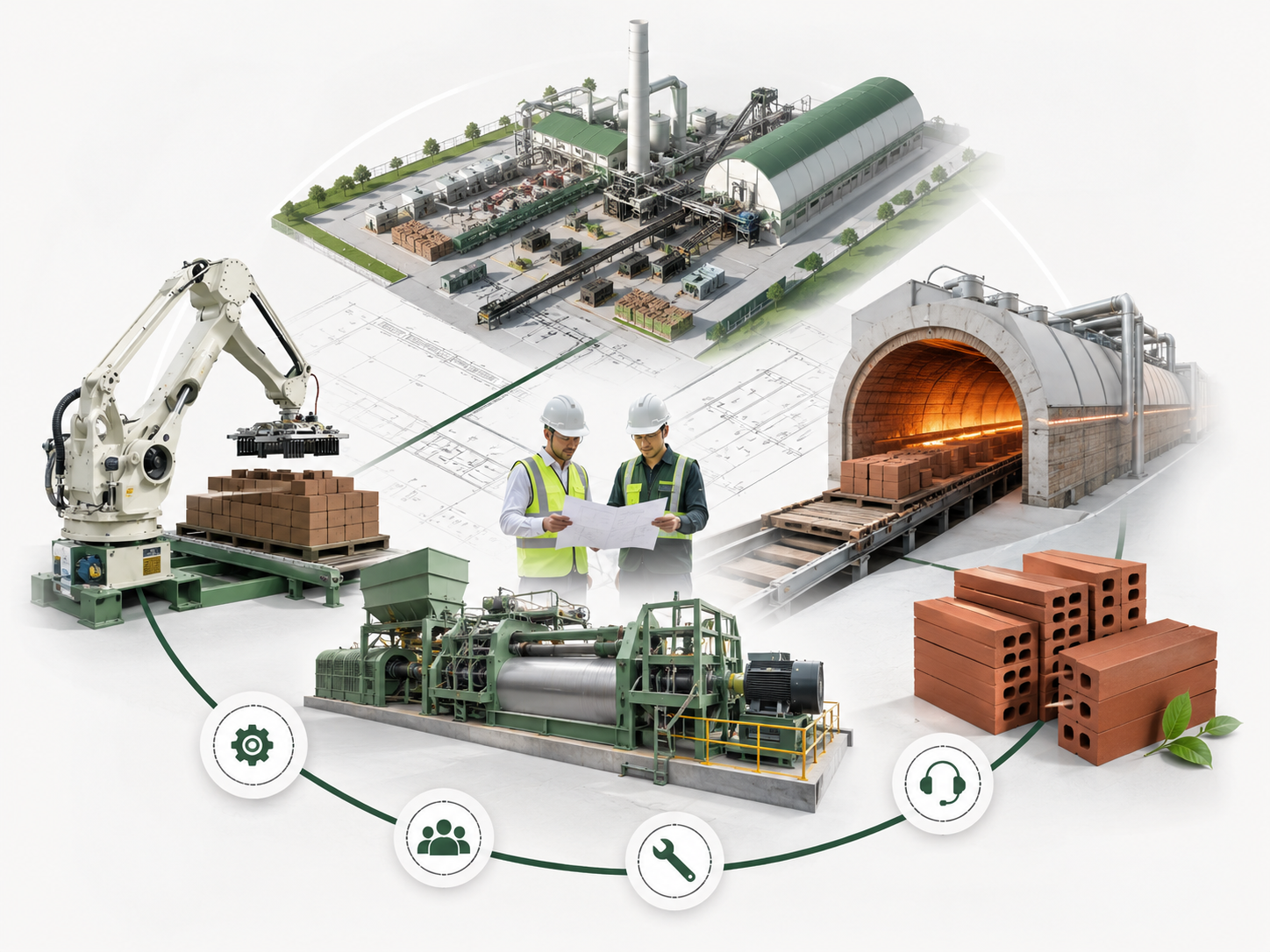
NES supports automatic clay brick projects from early feasibility through machinery supply, kiln and dryer engineering, layout coordination, installation guidance, commissioning, training and after-sales support.
A responsible project starts by matching local clay, fuel, climate, land, compliance route, product market and capital capacity. The recommended plant may be a Tunnel Kiln, a Hybrid Hoffman Kiln with controlled drying, or a phased modernization plan. The correct answer is the system that can be permitted, operated, maintained and repaid under the project’s real conditions.
Plant layout
Machinery matching
Kiln & dryer
Commissioning
Frequently asked questions
Brick-kiln regulation and investment FAQ
Are Tunnel Kilns and Hybrid Hoffman Kilns automatically legal in Bangladesh?
No. They are recognized in Bangladesh’s sustainable-finance framework, but a project still needs a lawful site, environmental clearance, kiln licence, permitted raw material, compliant fuel and observance of current local orders. Technology eligibility is only one part of compliance.
Does India’s 2022 rule require every owner to install a Tunnel Kiln?
No. The national notification expressly routes new kilns through zig-zag technology, vertical shaft or piped natural gas and sets emission, fuel and monitoring conditions. A proposed Tunnel or Hoffman system must be reviewed under the applicable central and state consent framework.
Which is better for a new plant: HHK or Tunnel Kiln?
HHK can suit medium-capacity projects seeking controlled production at lower capital than a fully automatic Tunnel system. Tunnel Kilns are stronger when scale, year-round drying, repeatable quality and automation justify the capital. Clay behaviour, legal approval, fuel, market and finance should decide.
Can a coal-fired Tunnel Kiln be called zero-emission?
No. A well-engineered coal-fired system can reduce fuel waste, visible smoke and regulated pollutants through combustion control, heat recovery and appropriate treatment, but it still produces emissions and requires monitoring and lawful operation.
What clay tests are essential for an automatic brick plant?
At minimum: representative deposit sampling, particle-size distribution, moisture and Atterberg limits, XRD, XRF, loss on ignition, salts/carbonate checks, extrusion trial, drying shrinkage and sensitivity, and multi-temperature pilot firing with strength, absorption, shrinkage and colour tests.
How should brick-plant ROI be calculated?
Use saleable output—not rated green output. Model net price, yield, fuel and electricity per saleable tonne, labour, maintenance, working capital, ramp-up, finance and taxes. Compare base, downside and upside cases, then calculate payback, NPV/IRR and debt-service coverage.
Can a traditional kiln become efficient only through new machinery?
Not necessarily. The 2025 Bangladesh trial showed that disciplined fuel feeding and brick setting can deliver large savings. For any kiln type, training, maintenance and measurement are essential. Machinery creates capability; operation determines performance.
Plan with verified inputs
Build a plant that is technically sound, financially defendable and approval-ready
Share your project location, target capacity, brick size, land area, clay test data, fuel source, power availability and preferred automation level. NES can prepare a practical technology direction and project-scope discussion.
Engineering and regulatory references
Sources were reviewed for this article in July 2026. Links are provided for reader verification; local rules and enforcement orders can change.
- Government of Bangladesh — Brick Manufacturing and Brick Kilns Establishment (Control) Act, 2013.
- Bangladesh Bank — Sustainable Finance Policy update, 2023.
- The Business Standard — Savar degraded-airshed declaration, August 2025; and Bangladesh Sangbad Sangstha — subsequent enforcement statement.
- Government of India — G.S.R. 143(E), environmental standards for brick kilns.
- Lok Sabha — answer on standards and financial support to brick kilns.
- The Kathmandu Post — Nepal’s 2026 kiln-emission and conversion requirements.
- British Geological Survey — Brick Clay Mineral Planning Factsheet, 2022.
- Climate and Clean Air Coalition — Brick Kilns Performance Assessment.
- Stanford University — summary of the 2025 randomized kiln-operation trial.
- World Bank — Modern Brick Kilns Yield Development Benefits in Bangladesh.
- Asian Development Bank — Financing Brick Kiln Efficiency Improvement Project.
- National Strategy for Sustainable Brick Production in Bangladesh.
- Bangladesh Brick Sector Roadmap — technology transition and financed subprojects.
- Climate technology factsheet — Hybrid Hoffman Kiln performance reference.